Title
How to Identify a Square Jaw and Choose the Right TreatmentDate
2026-07-20Views
1878
Medical Column
How to Identify a Square Jaw and Choose the Right Treatment
Hello, this is Dr. Cho Dong Pill of AB Plastic Surgery
When considering square jaw surgery, the most important step is not simply deciding on surgery first, but accurately identifying what is actually causing the face to look wide.
Even if the face appears broad, not every case is caused by the jawbone.
The bone structure, masseter muscles, fat, skin, and degree of sagging can interact and create a similar appearance.
During consultations, many patients ask, “Do I have a square jaw?”
However, it is difficult to make an accurate judgment based only on photographs. In some cases, the bone is prominent, while in others, the muscles or fat are the main cause.
There are also patients who believe that the problem comes from the bone, even though the actual cause is muscular or fatty tissue, allowing improvement without surgery.
In particular, an appearance resembling a square jaw may result from a combination of the bone structure, muscles, fat, and skin sagging. Therefore, determining the cause based only on the visible contour is difficult.
Depending on the current condition, surgery may be necessary, while in other cases, a simpler procedure may be sufficient. This is why an individualized approach is essential rather than applying the same surgery to every patient.
Below, we will explain how to identify a square jaw and which treatment methods may be considered depending on the cause.
Self Check for a Square Jaw
It is difficult to determine whether you have a square jaw simply based on the impression that “the face or lower face looks wide” or “the face looks angular.”
The following points may help with an initial assessment.
✅ The lower face appears wide and angular from the front
✅ The lower face looks especially prominent when biting down firmly
✅ The lower facial contour falls in a straight line rather than a soft curve
✅ The face appears wide in photographs or video calls
In particular, if the angle of the jawbone is clearly visible from the side, there may be a strong possibility of a prominent bony square jaw.
Types of Square Jaw by Cause
A square jaw is not caused by a single factor.
An accurate diagnosis requires determining the underlying cause.

Bone Dominant Type: The lower jawbone itself is prominent
Muscle Dominant Type: The masseter muscles are enlarged
Fat and Sagging Type: Fatty tissue and sagging skin are the primary causes
Even if the jawline appears similarly square, surgery may be required in some cases, while simpler procedures may be sufficient in others.
When the Cause Is Bone Structure → Square Jaw Surgery
When the lower jawbone itself is developed, there are limitations to how much improvement can be achieved with nonsurgical procedures. In this case, square jaw surgery is the most fundamental treatment option.
By removing and reshaping the prominent bone, the angular contour can be transformed into a smoother curve, allowing improvement in both frontal facial width and overall appearance.
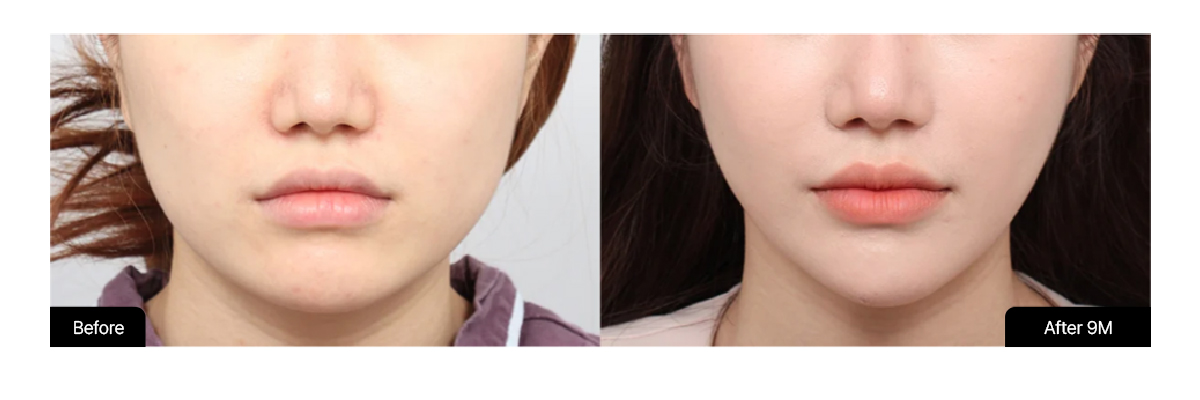
✅ Improvement of an angular contour into a natural curved line
✅ Reduction in frontal facial width
✅ Creation of a softer facial impression
Square jaw surgery should be performed after identifying the exact location of the nerve canal through a 3D CT scan and removing only the amount of bone that is truly necessary.
The goal is not simply to cut the bone into a smooth shape, but to leave an appropriate angle that suits the patient’s preferences, facial shape, and proportions. This is essential for a natural and satisfying surgical outcome.
When the Cause Is Muscle Development → Masseter Botox
A face may appear wide even when the jawbone itself is not prominent.
This is especially common in patients who frequently clench their teeth, as the masseter muscles can become enlarged.
In such cases, improvement may be achieved through Botox injections that reduce the volume of the muscles rather than through surgery.
✅ A relatively simple nonsurgical procedure
✅ Short recovery period
✅ Gradual slimming of the jawline over time
However, if the underlying cause is the bone structure, Botox alone has clear limitations.
When the Cause Is Fat or Sagging → Lifting and Fat Reduction
In many cases, the face appears square even though the bone itself is not actually prominent.
Common causes include localized fatty tissue and reduced skin elasticity.
In such cases, facial liposuction, lifting treatments, or a combination of both may help refine the jawline.
In other words, not every square jaw requires surgery. A precise analysis and an approach suited to the actual cause are important.
When Square Jaw Surgery May Be Necessary
Surgical improvement may be more appropriate in the following cases.
✅ The lower jawbone is clearly prominent
✅ The frontal lower face appears excessively wide
✅ Botox or nonsurgical procedures have not provided sufficient improvement
In these cases, improving the bone structure itself rather than relying only on simple procedures may provide a more stable result.
Square Jaw Improvement Checklist
The following criteria should be carefully reviewed when considering square jaw correction.
✅ Has the bone structure been accurately analyzed through a 3D CT scan?
✅ Have the muscles, fat, and other contributing causes been assessed together?
✅ Does the surgeon have sufficient experience in facial contouring surgery?
✅ Can the design take the overall balance of the face into account?
Only when these criteria are met can unnecessary surgery be avoided and a natural result be achieved.
Expected Changes After Square Jaw Surgery
Square jaw surgery is not simply a procedure that reduces the width of the jaw.
It is a facial contouring procedure that refines the overall proportions of the face.
✅ Improvement in frontal facial width
✅ A smoother transition along the angular jawline
✅ Refinement of the contour into a naturally curved line
However, the degree of change may vary depending on the individual’s bone structure and facial proportions. Therefore, a detailed preoperative assessment is essential.
Key Points to Consider When Planning Square Jaw Surgery
Square jaw surgery is not only about removing the angle of the jaw. The final result can vary greatly depending on how the entire facial contour is designed.
The following factors are particularly important in determining how natural and satisfying the result will be.
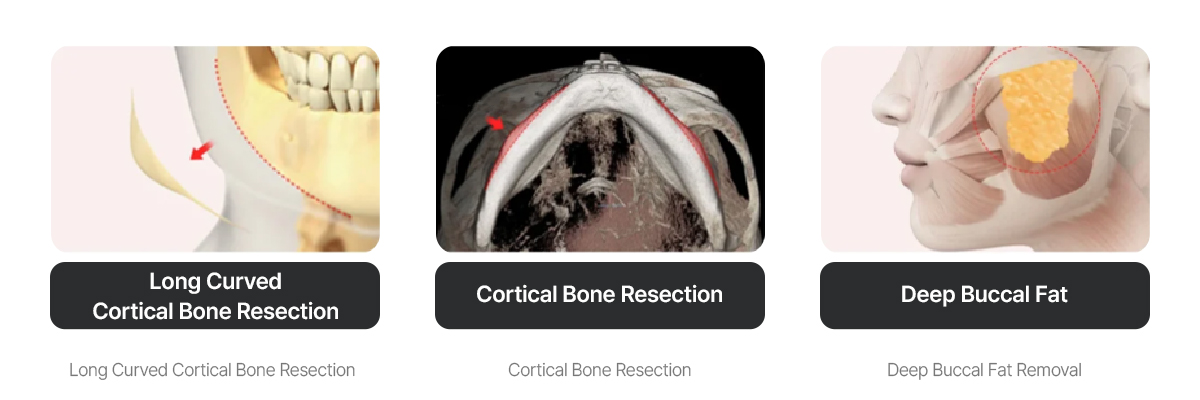
Extended Curved Resection to Prevent a Secondary Angle
The bone is smoothly resected along a curve from the area behind the individual’s mandibular angle to the front of the jaw, depending on the facial shape. This helps prevent a secondary angle or an unnaturally stepped contour.
tal Width
By removing the outer cortical layer together with the angle of the jaw, the thickness of the bone can be reduced, allowing the face to appear slimmer not only from the side but also from the front.
Long Curved Resection
When the lower jawbone is highly developed, adjusting the contour together with square jaw surgery can reduce the appearance of a blunt or abrupt jawline after surgery and create a more refined facial contour.
Wide Jaw Correction
Reducing only the angle of the jaw may not provide sufficient change in the frontal appearance. In some cases, it is therefore important to perform wide jaw correction simultaneously, allowing the contour to transition naturally from the square jaw area to the chin.
Square jaw surgery is not simply a bone cutting procedure. Since the design must be connected to the overall facial proportions, a precise plan that considers the patient’s bone structure and soft tissue condition is necessary.
At AB Plastic Surgery Clinic, these factors are carefully considered to provide customized square jaw surgery suited to each patient’s facial shape.
“Square jaw correction is not simply about making the face smaller. It is a process of creating balance and harmony across the entire face.”
The most important step is to accurately identify the cause and select the treatment that best suits the individual.
Reducing only the angle of the jaw may instead make the face appear longer or cause the cheekbones to look more prominent. For this reason, the surgical method must be selected carefully.
The final result can vary depending on the patient’s bone structure, muscle development, and overall facial condition.
For further information regarding facial contouring surgery, please contact AB Plastic Surgery on WhatsApp at +82 10 4393 1298 for a detailed consultation.
|
Writer. Dr. Cho Dong Pill, AB Plastic Surgery |