Title
SOFIT Rhinoplasty: How Is It Different from Conventional Rhinoplasty? When Is a Customized Implant Needed?Date
2026-09-14Views
644
Medical Column
SOFIT Rhinoplasty: How Is It Different from Conventional Rhinoplasty? When Is a Customized Implant Needed?
Hello, this is Dr. Koo Won Young of AB Plastic Surgery.
One of the most common questions I receive during rhinoplasty consultations is, “Which type of nasal implant would be best for me?”
In particular, when the nasal bridge is low or when the nasal structure is relatively short or asymmetrical, patients often wonder whether a conventional implant or a customized implant would be more appropriate.
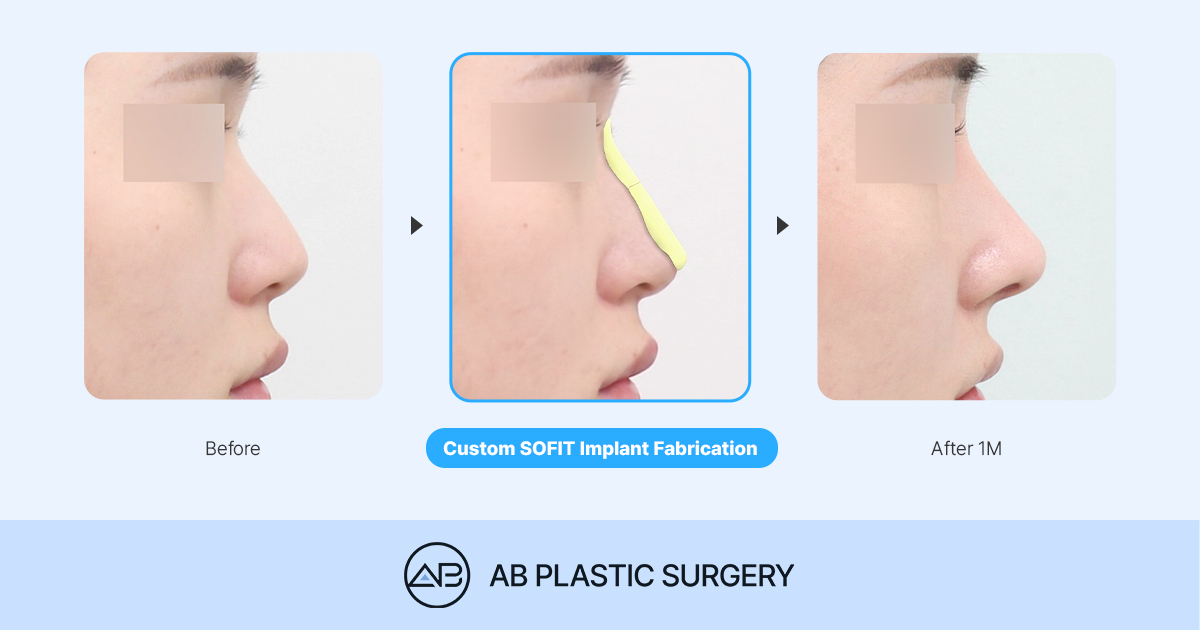
Recently, SOFIT, a customized nasal implant created by analyzing each patient’s nasal structure based on 3D CT imaging, has been increasingly used to reflect both medical considerations and the patient’s desired design.
Unlike conventional prefabricated implants, SOFIT is individually designed according to each patient’s anatomical structure and surgical plan. Because of this, it may be applied more precisely in cases such as contracted nose revision, deviated nose correction, and revision rhinoplasty.
So, how do we determine whether a conventional implant or a customized implant is more appropriate for rhinoplasty?
Not every patient requires a customized implant. However, depending on the complexity of the nasal structure, degree of asymmetry, and desired nasal shape, a customized implant may offer a more suitable option.
In this article, we will explain the differences between conventional nasal implants and the customized SOFIT implant, when a customized implant may be helpful, how it is manufactured, and what should be considered when selecting a rhinoplasty clinic.
Q. How Is the 3D Customized SOFIT Implant Different from a Conventional Implant?
The biggest difference is whether the implant is manufactured specifically according to the patient’s individual nasal structure from the beginning.
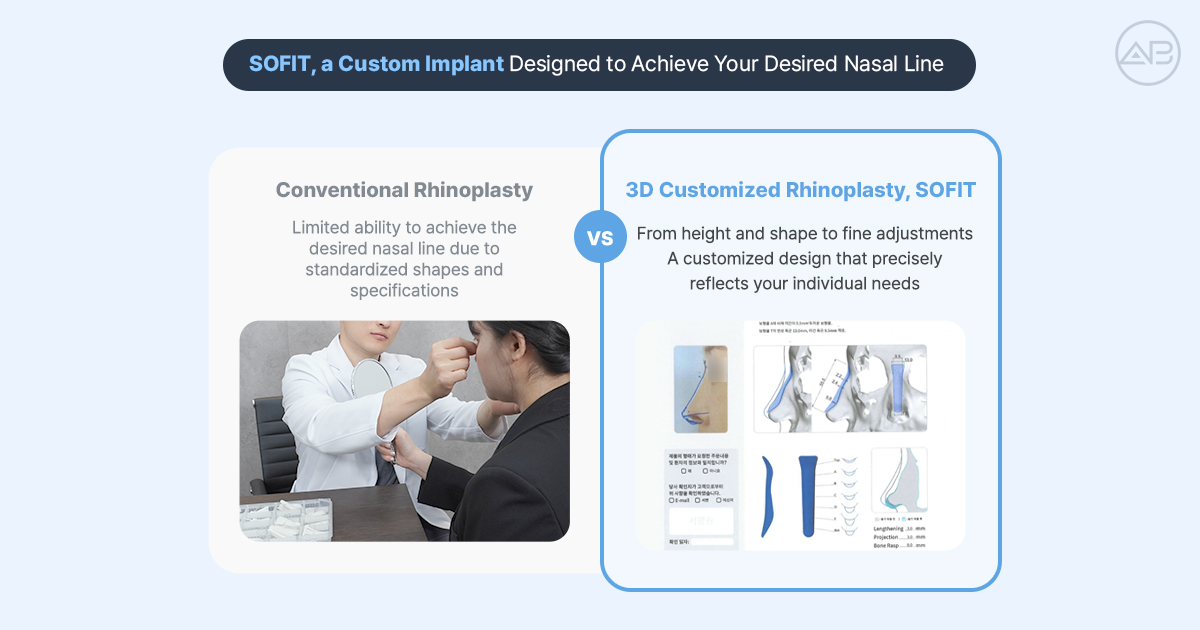
Conventional nasal implants are standardized products manufactured in predetermined shapes and dimensions. The surgeon selects an implant that is relatively suitable for the patient’s nose and may trim or modify it during surgery as needed.
However, because conventional implants are made in standardized shapes, there may be limitations in precisely adapting them to the patient’s unique anatomy and desired nasal design.
In contrast, SOFIT is a 3D customized nasal implant designed by analyzing the patient’s nasal shape and facial proportions using 3D CT imaging and facial photographs, while also reflecting the surgeon’s surgical plan.
Because the implant is designed according to the patient’s individual anatomical structure, it can better reflect the curvature of the nasal bridge, and it can be manufactured more precisely according to the surgical plan.
A customized implant may also help minimize unnecessary trimming by being designed to fit the patient’s nasal anatomy and by adjusting only the required areas within the necessary range. This may help reduce unnecessary manipulation of surrounding tissue and allow the implant to be positioned more appropriately.
In other words, rather than simply considering SOFIT a “better implant,” it is more accurate to understand it as an implant that is customized according to the patient’s anatomy and surgical plan.
|
Category |
Conventional Implant |
Customized SOFIT Implant |
|
Manufacturing Method |
A standardized prefabricated rhinoplasty implant is selected and trimmed during surgery when necessary |
A 3D customized rhinoplasty implant manufactured by analyzing the patient’s individual anatomical structure |
|
Surgical Approach |
Additional trimming of the implant or adjustment of surrounding tissue may be required to adapt the prefabricated shape to the patient’s nose |
Designed based on 3D CT imaging to fit the curvature and structure of the patient’s nasal bridge, helping minimize unnecessary trimming and tissue adjustment |
|
Suitable Cases |
Cases requiring relatively simple correction of nasal shape |
Cases involving structural issues such as contracted nose revision, deviated nose, or revision surgery following rhinoplasty complications |
Q. How Is the Customized SOFIT Implant Made?
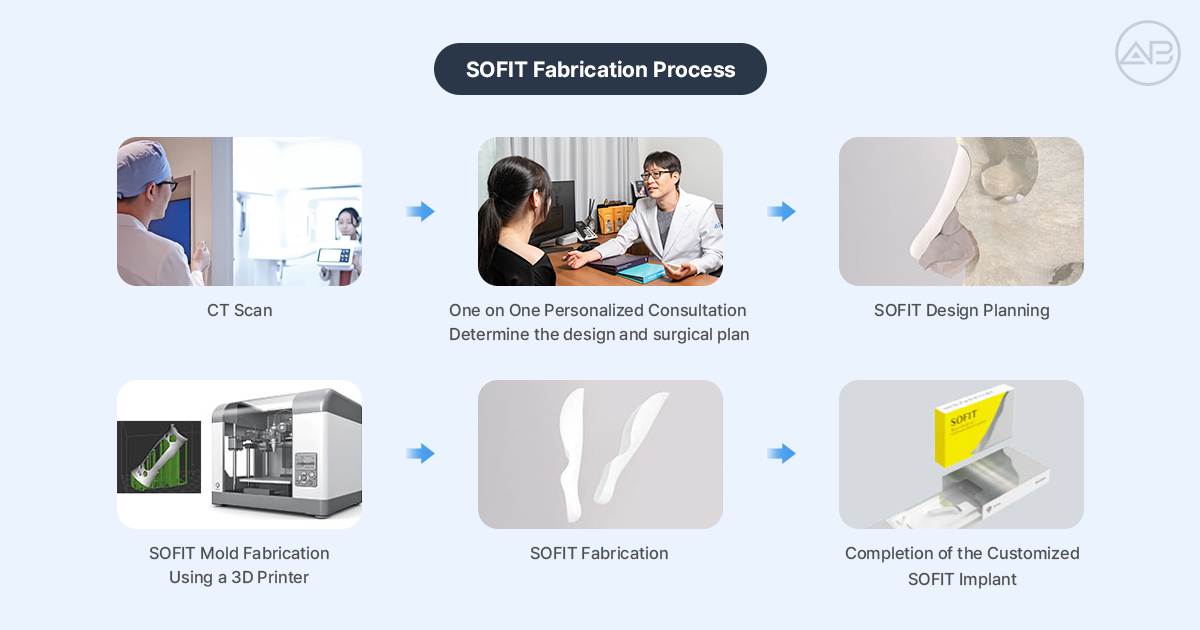
3D CT and medical photography → One on one consultation and design → Customized implant manufacturing → Quality inspection and sterilization → Surgery
Because the implant is designed according to the patient’s individual anatomy and surgical plan, the information collected at each stage and the surgeon’s clinical judgment are important.
First, 3D CT imaging is used to evaluate the shape and curvature of the nasal bridge, asymmetry, and internal anatomical structures.
The surgeon then reviews facial photographs to assess the overall facial shape and proportions and conducts a one on one consultation to determine the patient’s preferred nasal design and surgical direction.
Based on this information, including the 3D CT analysis of internal nasal structures and the analysis of overall facial shape and proportions from medical photographs, the height, length, and other dimensions of the implant are designed.
After manufacturing, the implant undergoes quality inspection and sterilization before being used during surgery.
In other words, a customized implant is not simply manufactured to match the external shape of the nose. It is designed by comprehensively analyzing the patient’s nasal anatomy, facial harmony, and surgical objectives in order to support a surgical plan that is appropriate for the individual patient.
Q. In What Cases May SOFIT Be Recommended?
A customized implant is not necessary for every rhinoplasty patient.
However, SOFIT rhinoplasty may be considered when the nasal structure is complex or when it is difficult to achieve the desired design without excessive trimming or modification of a prefabricated implant.
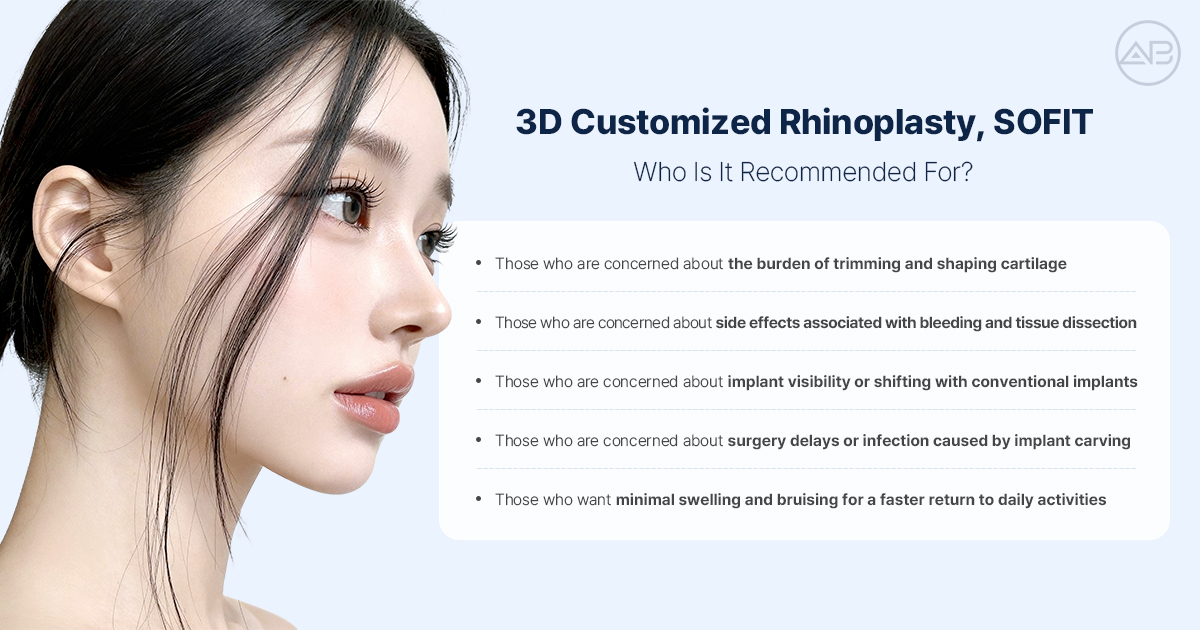
Particularly in cases such as contracted nose revision, deviated nose correction, or revision rhinoplasty, where the structural characteristics of the nose must be evaluated carefully, the process of repeatedly trimming and adjusting a conventional implant to fit the individual nasal anatomy may be necessary.
When this process is repeated, the operation may take longer and unnecessary manipulation of surrounding tissue may increase.
In contrast, SOFIT rhinoplasty analyzes the patient’s nasal structure using 3D CT imaging and allows the implant to be designed in advance according to the surgical plan. This may help reduce intraoperative trimming and allow the planned nasal shape to be reproduced more precisely.
Customized implants may also be useful in cases where excessive trimming of the nasal bridge is expected to be necessary or where a more precise design is required due to asymmetry.
By designing the implant while considering both the nasal structure and the overall surgical plan, it may help minimize unnecessary removal of the nasal bridge while preserving as much of the patient’s original anatomy as possible.
For this reason, SOFIT may be actively considered in cases where the patient has distinctive structural characteristics or where the desired nasal line may be difficult to achieve using a conventional prefabricated implant alone.
Through a customized and precise design based on the patient’s individual anatomy, it may help create a more detailed nasal shape and improve overall surgical satisfaction.
Q. Then, What Criteria Should Be Used When Choosing a Rhinoplasty Clinic?
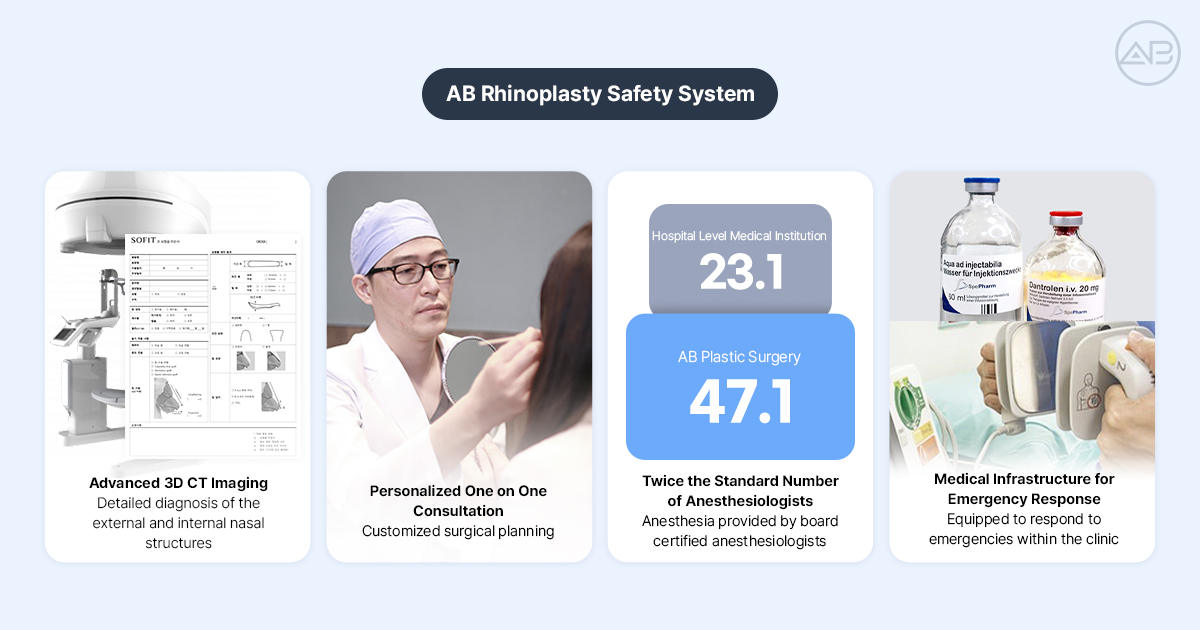
First, it is important to determine whether the clinic is capable of conducting precise diagnostic evaluation using 3D CT imaging before surgery, and whether the medical team sufficiently understands both conventional and customized implants, including their respective indications.
It is also important for the surgeon to comprehensively evaluate the patient’s nasal structure and overall facial proportions, determine which implant is appropriate for each case, and recommend a suitable surgical approach.
In addition, the clinic’s safety management system should be carefully reviewed.
This includes whether anesthesiology specialists are present throughout the entire surgical process, whether continuous monitoring is performed during surgery, whether an infection control system is in place, whether preoperative health screening is conducted, whether postoperative recovery and follow up care are systematically provided, and whether emergency response protocols are established.
Ultimately, when selecting a clinic for rhinoplasty, it is preferable not to judge based solely on a specific implant or surgical technique. Instead, the clinic should be evaluated based on whether it can establish an individualized surgical plan through accurate diagnosis and whether it has a systematic safety management process covering every stage from preoperative evaluation to surgery and postoperative care.
When these processes are managed systematically, they may help reduce the risk of rhinoplasty complications and contribute to a more satisfactory surgical outcome.
For more information regarding customized nasal implants or SOFIT rhinoplasty, please contact AB Plastic Surgery on WhatsApp at +82 10 4393 1298 for a detailed consultation.

|
Writer, Dr. Koo Won Young, AB Plastic Surgery |