Which Surgery Do I Need for Asymmetrical Eye Correction?

I am Dr. Jeong Yeon-Woo, a board certified plastic surgeon at AB Plastic Surgery.
Many patients visit us for consultation because they are concerned about asymmetry between their eyes, often referred to as asymmetrical eyes. In fact, almost everyone who comes in for eye surgery consultation has some degree of asymmetry. The difference lies only in how noticeable it is, as perfectly symmetrical eyes are rare.
Various factors can cause asymmetrical eyes, including differences in the left and right orbital bone structure, differences in eyelid opening strength, the degree of eyebrow drooping, and sagging skin. Therefore, correcting asymmetrical eyes requires a customized surgical approach based on the exact cause.
Asymmetrical Eyes That Can Be Corrected with Ptosis Correction


“Ptosis correction” is also commonly referred to as “sleepy eye correction” or “blepharoptosis correction.” This procedure adjusts the strength of the muscles used to open the eyes, making it easier to open the eyes and increasing the exposure of the iris, which helps the eyes appear clearer and more defined.
When too much of the iris is covered, the eyes may look sleepy or unfocused. In general, it is considered ideal for the upper part of the iris to be covered by approximately 1 to 2 mm. Therefore, asymmetry caused by a difference in eyelid opening strength can be improved through ptosis correction.
Cases That Cannot Be Corrected with Ptosis Correction Alone
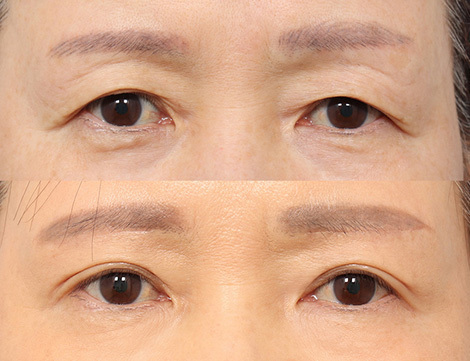
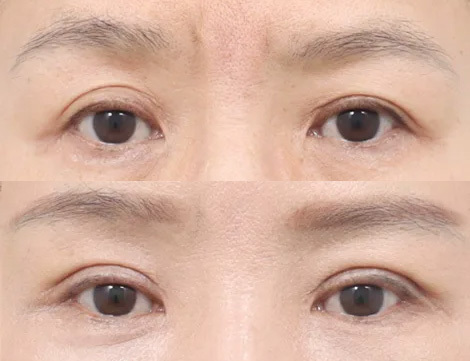
However, not all cases of asymmetrical eyes are caused only by differences in eyelid opening strength. Asymmetry may also result from sagging skin, differences in bone structure, or differences in eyebrow position. In these cases, ptosis correction alone has limitations, and additional correction suited to the underlying cause may be necessary.
Sagging skin: Correcting excess or drooping skin through incisional double eyelid surgery, upper blepharoplasty, or sub brow lift
Differences in eyebrow position: Balancing the height of both eyebrows through a forehead lift
Differences in bone structure: Creating a customized surgical plan that considers the correctable range and limitations caused by structural differences in the orbital bones
Therefore, to correct asymmetrical eyes, it is essential to accurately diagnose the cause and apply the appropriate method in order to achieve a result that is as balanced as possible.
Realistic Goals of Asymmetrical Eye Correction
Perfect symmetry like a mirror image cannot be created. The goal is to reduce asymmetry and create the most natural and harmonious impression possible. When reviewing Plastic surgery before&after cases, it is important to understand that the goal of asymmetrical eye correction is not perfect symmetry, but a more balanced, natural, and harmonious appearance.
In other words, asymmetrical eye correction is not simply about making both eyes look exactly the same. It is a process of finding the most ideal balance and natural appearance according to each patient’s individual condition.
Asymmetrical eye correction cannot be solved with double eyelid surgery alone. It requires a customized solution that comprehensively considers eyelid opening strength, skin condition, bone structure, and eyebrow position. For patients considering Plastic surgery in korea, asymmetrical eye correction should be planned after carefully evaluating eyelid opening strength, skin condition, eyebrow position, and orbital bone structure. Therefore, it is most important to have a thorough consultation with an experienced board certified plastic surgeon and establish a surgical plan that is suitable for you.
For more information about asymmetrical eye correction, please contact AB Plastic Surgery on WhatsApp at +82 10 4393 1298 for a detailed consultation.

|
WriterDr. Jeong Yeon-Woo, AB Plastic Surgery |