Title
Body Contouring Before and After in Korea: Results, Recovery, and What to CheckDate
2026-11-18Views
29
AB Blog
Body Contouring Before and After: How Your Body Changes by Area, Body Type, and Recovery Stage
Table of Contents
1. What Changes Before and After Body Contouring
2. Body Contouring Before and After by Area: Abdomen, Arms, Thighs, and Hips
3. Before and After by Starting Body Type
4. Recovery Timeline: How Your After Result Develops from Week 1 to Month 12
5. Frequently Asked Questions About Body Contouring Before and After
6. What to Check Before Booking Body Contouring in Korea
7. Body Contouring Cost in Korea and How to Keep Your Results
Most people who consider surgery to reshape their body are asking one practical question: what will actually be different afterward? A body contouring before and after is not only a change on the scale. It is a change in where the body curves, how clothes fit, and how balanced the waist, arms, thighs, and hips look together.
This guide explains what typically changes before and after body contouring in Korea, how the change differs by body area and by starting body type, how the result develops from the first week to the first year, and what to check before booking. It is written by AB Plastic Surgery Korea, a KAHF-accredited plastic surgery hospital in Gangnam, Seoul, for international patients planning body contouring as part of medical travel.
At a Glance: Body Contouring in 2025–2026
-
From fat removal to reshaping: According to the American Society of Plastic Surgeons (ASPS) 2025 Procedural Statistics Report, liposuction remained one of the most-performed cosmetic surgeries in the United States (317,196 procedures), while upper body lifts rose 22%, arm lifts 21%, and thigh lifts 20%.
-
The GLP-1 effect: The same ASPS report found that 82% of member surgeons received consultation requests related to GLP-1 weight-loss medication in 2025.
-
Korea as a destination: Korea’s Ministry of Health and Welfare reported 2.01 million foreign patients in 2025, with U.S. patients rising 70.4% to about 173,000.
-
The after takes time: Liposuction contours usually settle at around six months, and procedures that remove skin often take six to twelve months.
What Changes Before and After Body Contouring
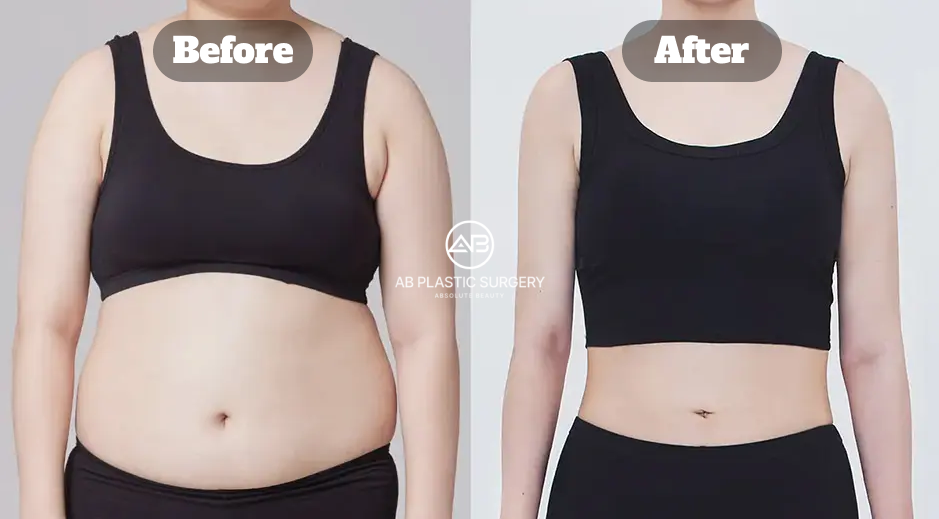
In short: The main difference before and after body contouring is shape and proportion. Localized fat is reduced, loose skin can be removed, and volume can be added where the body looks flat. The result shows up as a defined waist, slimmer arms and thighs, smoother transitions between areas, and a better fit in clothing, while body weight may change only modestly.
Body contouring is an umbrella term for procedures that reshape the body rather than reduce weight. It includes liposuction, abdominoplasty (tummy tuck), arm and thigh lifts, and fat grafting. Each one creates a different kind of before-and-after change, so knowing which procedure fits your concern is the first step to a realistic expectation.
Before and After by Procedure
|
Procedure |
Before: the typical concern |
After: what usually changes |
What it does not change |
|---|---|---|---|
|
Liposuction |
Stubborn fat in the abdomen, flanks, thighs, arms, or back that resists diet and exercise |
Reduced localized fat, a defined waist, and slimmer, smoother lines |
Significant loose skin, cellulite, or overall body weight |
|
Abdominoplasty |
Hanging lower-abdominal skin, often after pregnancy or major weight loss, sometimes with separated abdominal muscles |
A flatter, firmer lower abdomen and a tightened abdominal wall where indicated |
The lower-abdominal scar is permanent |
|
Arm lift / thigh lift |
Loose, hanging skin on the upper arms or inner thighs |
A tighter, smoother limb outline |
A scar along the inner arm or thigh is the trade-off |
|
Fat grafting (hip or breast) |
Flat areas, hip dips, or volume loss |
Added curve and softer transitions using your own fat |
Part of the grafted fat may not survive, so volume settles over months |
Shape, Not Scale
Because fat is relatively light for its volume, the number on the scale often changes far less than the silhouette does. Many patients notice the before-and-after difference first in their clothing: trousers that close more easily at the waist, sleeves that sit looser on the upper arm, or a dress that follows the body instead of pulling at the hips.
To document change beyond appearance, AB Plastic Surgery measures body composition, including weight, skeletal muscle mass, body fat mass, and percent body fat, before surgery and through recovery. One case published on AB’s liposuction page shows weight moving from 58.0 kg to 48.6 kg and body fat mass from 29.0 kg to 18.1 kg over the tracked recovery period. That figure reflects one patient’s surgery, aftercare, and lifestyle together, so it shows how change can be measured rather than what every patient should expect.
What Body Contouring Does Not Change
-
Future weight gain: Remaining fat cells can still enlarge if weight increases after surgery.
-
Skin texture: Liposuction does not remove cellulite or stretch marks. Abdominoplasty removes only the marks on the skin that is excised.
-
Aging: Skin and tissue continue to age naturally after any procedure.
-
Health conditions: Body contouring is not a treatment for obesity or metabolic disease.
Body Contouring Before and After by Area: Abdomen, Arms, Thighs, and Hips
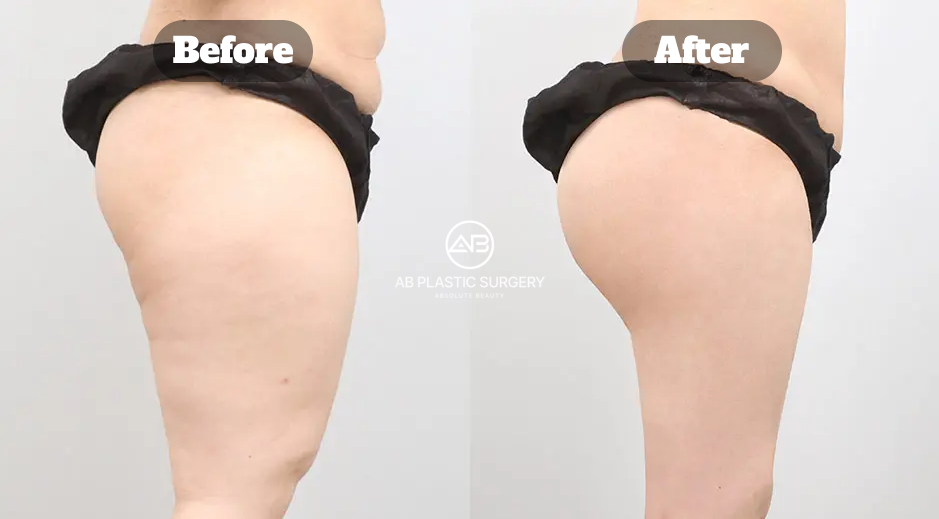
In short: Each body area changes differently. The abdomen gains a curved waistline, the arms gain a straighter line from shoulder to elbow, the thighs gain a slimmer, straighter leg line, and the hips gain a smoother transition into the thighs. The best results look proportionate to the rest of the body, not only smaller.
AB Plastic Surgery describes its liposuction as a hand-performed technique that considers muscle movement, bone structure, and the post-operative body line rather than fat volume alone. The table below summarizes how that approach applies to each area.
|
Area |
Common concern before |
Typical change after |
AB’s design focus |
|---|---|---|---|
|
Abdomen and waist |
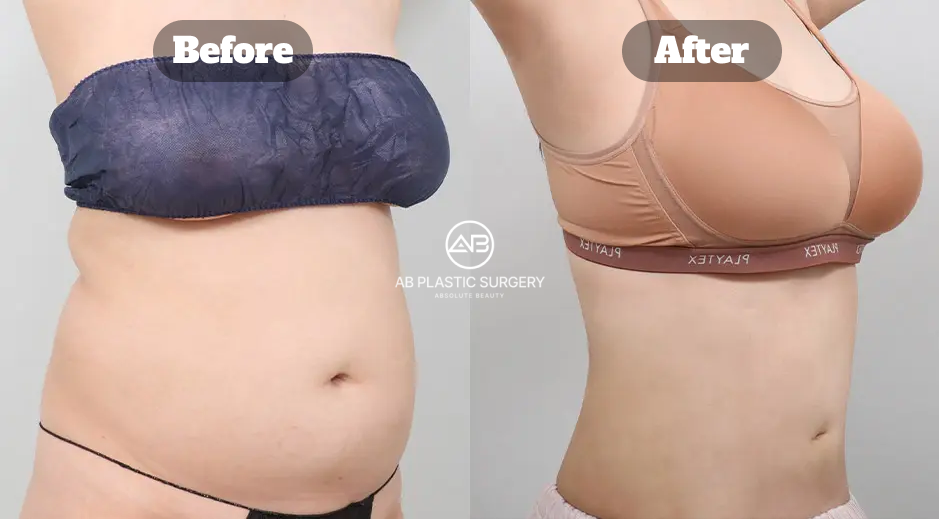
Lower-belly bulge, love handles, no visible waist |
A flatter front and an inward curve at the waist |
The curve between the lower ribs and the pelvis |
|
Arms |
Fullness at the back of the upper arm and near the armpit |
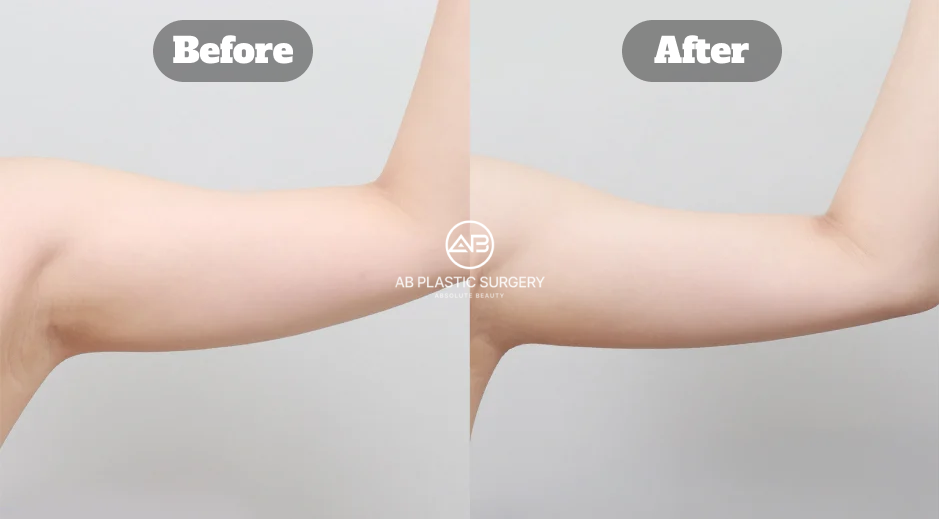
A slimmer, straighter arm line |
Shoulder–arm movement and muscle structure |
|
Thighs |
Inner-thigh rubbing, outer-thigh “saddlebags” |
A slimmer, straighter leg line |
Thigh muscles and overall leg proportion |
|
Hips and buttock line |
Sagging lower buttock, blurred hip-to-thigh border |
A lifted look and a continuous hip-to-thigh curve |
Buttock sagging, thigh contour, and the hamstrings |
Abdomen and Waist
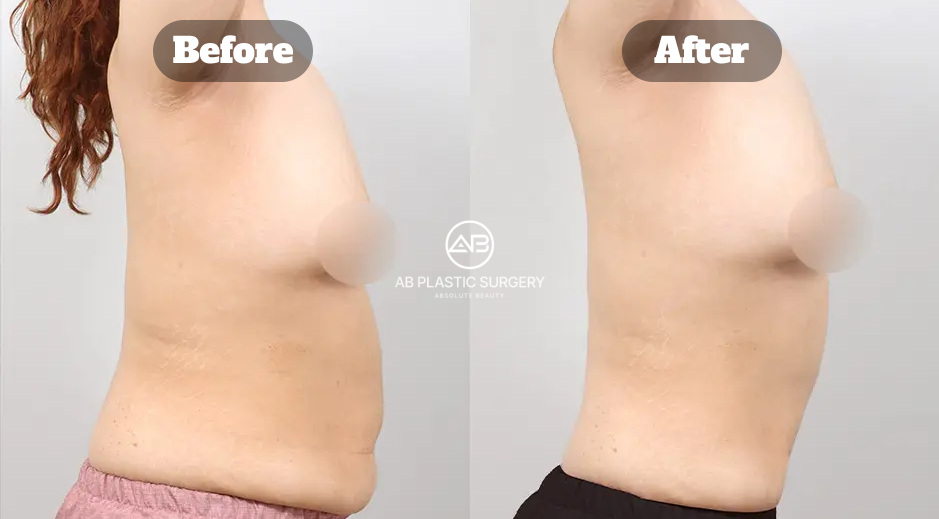
Before surgery, the abdomen often looks straight from the ribs to the hips, with fat collecting below the navel and at the flanks. After liposuction, the lower abdomen flattens and the sides curve inward, creating a waistline. AB designs abdominal liposuction around the curve between the ribs and the pelvis, aiming for a balanced “cola-bottle” outline rather than an abdomen that is simply flat from side to side.
When the main concern is skin that folds or hangs below the navel, liposuction alone usually cannot create a smooth result. Abdominoplasty, sometimes combined with liposuction of the flanks, changes the abdomen more completely by removing that skin and, where needed, tightening the abdominal wall.
Arms
The most common before-concern is fullness at the back of the upper arm that makes the arm look wide in sleeveless clothing. After arm liposuction, the line from the shoulder to the elbow becomes slimmer and straighter. AB’s design considers shoulder–arm movement and muscle structure, so the result looks natural when the arm moves, not only when it rests. If the arm has loose, hanging skin, an arm lift may be needed to achieve a similar change.
Thighs
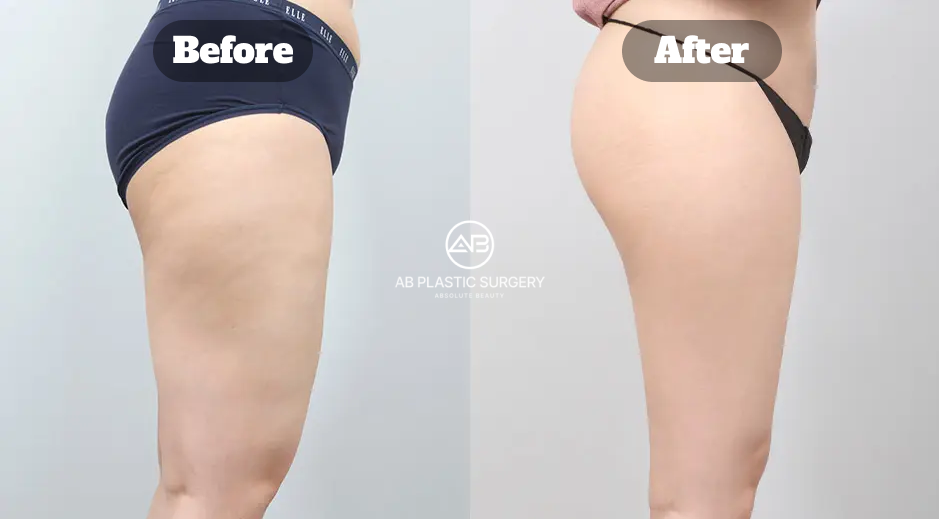
Before thigh liposuction, patients often describe inner thighs that rub when walking or outer thighs that widen the hip line. After surgery, the leg line becomes slimmer and straighter, and the gap between the thighs may increase. Because skin on the thigh can be thin, careful removal matters to avoid hollows. AB plans thigh liposuction around thigh muscle structure and overall leg proportion, aiming for a straighter leg line that can make the legs appear longer, rather than maximum fat extraction.
Hips and Buttock Line
The hip area is often reshaped in two ways at once: fat is removed from the flanks and lower back to sharpen the waist, and fat may be grafted into the hips or buttocks to add curve. After surgery, the border between the buttock and the thigh looks clearer and the buttock appears lifted, even without implants. AB’s design for this area takes into account buttock sagging, thigh contour, and the hamstring muscles beneath.
Combining Several Areas
Because the eye reads the body as a whole, treating connected areas, such as the abdomen with the flanks, or the thighs with the hips, often produces a more harmonious before-and-after than treating one area alone. The total volume and operating time in a single session must still stay within safe limits, which are set for each patient after pre-operative health screening. To see real AB body contouring changes by area, browse AB Plastic Surgery’s before and after cases.
Before and After by Starting Body Type
In short: Where you start shapes what changes. Slimmer patients with localized fat usually see the sharpest line definition. Patients with more body fat often see a larger change in overall size and silhouette. Patients after major weight loss or pregnancy usually see the biggest change when loose skin is addressed, not fat alone.
Two patients can have the same procedure and very different before-and-after changes. AB Plastic Surgery states that it treats a wide range of body types, from patients with a small frame and localized fat to plus-size patients concerned about their overall figure. The groups below explain how the change typically differs.
Slim Build with Stubborn Localized Fat
These patients are often close to their ideal weight but have fat that stays in one or two areas, such as the lower abdomen or the inner thighs. Because skin elasticity is usually good, the skin contracts well after liposuction. The before-and-after change is mainly in definition: sharper waist curves, straighter thighs, and slimmer arms, with only a small difference on the scale.
Higher Body Fat or Plus-Size Figure
For patients with more body fat across several areas, the change is often in overall size and silhouette as well as shape. AB’s liposuction page includes a pre-operative body composition example of a patient measuring 161 cm and 78.0 kg, with a BMI of 29 and a body fat percentage of 46.5%, to illustrate how plans are built from measured data. For these patients, large-volume plans may be staged across separate sessions for safety, and a healthy routine after surgery has a strong effect on how well the result holds.
After Major Weight Loss or GLP-1 Medication
The growth in lift procedures reported by ASPS reflects a common situation: patients who have lost significant weight, often with GLP-1 medication, find that their main concern is no longer fat but loose skin. In these bodies, liposuction alone may leave skin looking less supported. The most noticeable before-and-after change usually comes from skin-removing procedures such as abdominoplasty, an arm lift, or a thigh lift, sometimes combined with liposuction.
Surgeons generally prefer to plan surgery once weight has stabilized, because further loss or gain can change the result. If you are still adjusting your weight with GLP-1 medication, our guide to liposuction with Wegovy and Mounjaro in Korea explains how timing affects surgical planning.
After Pregnancy
Pregnancy can stretch the abdominal skin and separate the abdominal muscles, leaving a lower-belly bulge that does not respond to exercise. Before surgery, the abdomen often looks rounded even at a stable weight. After abdominoplasty, the lower abdomen looks flatter and firmer because both the skin and, where needed, the muscle layer are addressed. Surgeons usually recommend waiting until you have finished having children, because a future pregnancy can stretch the abdomen again.
Recovery Timeline: How Your After Result Develops from Week 1 to Month 12
In short: The “after” is not visible all at once. Swelling is greatest in the first week, the new contour becomes clear at around one to three months, and liposuction results usually settle by about six months. Procedures that remove skin often need six to twelve months, and scars continue to mature beyond that.
Many patients are surprised that they look swollen, or even larger, in the first days after surgery. The ranges below are general patterns; your surgeon will give you a timeline based on your procedure and healing.
|
Stage |
What you typically experience |
How the result looks |
|---|---|---|
|
Days 1–7 |
Swelling, bruising, tightness, and a compression garment worn most of the day; drains in some skin-removing procedures |
The treated area may look swollen; this is not the result yet |
|
Weeks 2–4 |
Bruising fades, light daily activity returns, and the garment continues |
An early change in shape; firmness and mild unevenness are normal |
|
Months 1–3 |
Most swelling resolves and the skin adapts to the new contour |
The new shape becomes clear, though it is still refining |
|
Months 6–12 |
Liposuction contours settle; scars from skin removal soften and fade |
The final before-and-after difference |
Compression and Aftercare at AB Plastic Surgery
How recovery is managed affects how smoothly the final contour forms. According to AB Plastic Surgery, liposuction patients receive a customized compression garment and a home-care kit, followed by in-clinic sessions that combine LDM and high-frequency therapy, with a de-swelling IV drip added in the second session. AB also states that it operates a 24-hour liposuction call center, so patients can reach the clinic if a concern arises after they return to their hotel.
Anesthesia Safety Shapes Recovery, Too
A smoother recovery begins in the operating room. Body contouring can involve large treatment areas and tumescent fluid, which makes anesthesia and fluid management important. At AB Plastic Surgery, a board-certified specialist in anesthesiology and pain medicine is on site for every procedure. The clinic states that the anesthesia method is designed from a suitability assessment, that each patient receives dedicated one-to-one anesthesia monitoring with a central monitoring system providing an extra layer of oversight, and that emergency medications and antidotes are prepared in advance.
How Long to Stay in Korea
Your stay should cover consultation, surgery, the most swollen first days, and at least one follow-up check before you fly. As a general planning range, liposuction of one or two areas is often planned around seven to ten days, while abdominoplasty or arm and thigh lifts usually require a longer stay of around ten to fourteen days. Your surgeon will confirm the right length based on your plan. For surgeon-written explanations of recovery and complications, AB Plastic Surgery’s medical column covers a wide range of procedures in detail.
Before You Fly Home
-
Complete your final in-clinic check-up and confirm wound or incision status.
-
Get written instructions for how long to wear your compression garment.
-
Save the clinic’s contact line and your coordinator’s details.
-
Ask how follow-up questions will be handled after you return home.
-
Discuss flight timing and movement on long flights with your medical team.
Frequently Asked Questions About Body Contouring Before and After
When will I see my final body contouring result?
For liposuction, most swelling resolves within about three months, and the contour usually settles by around six months. For procedures that remove skin, such as abdominoplasty or arm and thigh lifts, the final shape often takes six to twelve months, and scars continue to fade after that.
Will I lose a lot of weight after liposuction?
Not necessarily. Liposuction is designed to change shape, not to treat weight. The change in your silhouette and clothing fit is often much greater than the change on the scale. Body composition measurements, such as body fat mass and percent body fat, describe the change more accurately than weight alone.
Are body contouring results permanent?
Fat cells removed by liposuction do not grow back, and skin removed during a lift or abdominoplasty is gone. However, the remaining fat cells can still enlarge if you gain weight, and skin continues to age. Keeping a stable weight is the most important factor in maintaining your result.
Can liposuction fix loose skin after GLP-1 weight loss?
Liposuction removes fat but does not remove excess skin. If significant weight loss has left skin that folds or hangs, procedures that remove skin, such as abdominoplasty, an arm lift, or a thigh lift, are usually considered, sometimes combined with liposuction. Surgeons generally recommend planning surgery once your weight has stabilized.
How many days should I stay in Korea for body contouring?
As a general guide, liposuction of one or two areas is often planned around seven to ten days, including consultation, surgery, and a follow-up check. Abdominoplasty or arm and thigh lifts usually need around ten to fourteen days. Your surgeon will recommend a schedule based on your procedure, the number of areas treated, and how you heal.
Can several body areas be treated in one surgery?
Often, yes. Many plans combine areas such as the abdomen, flanks, and thighs for a more balanced result. However, the total volume and operating time must stay within safe limits for each individual. Those limits are decided after pre-operative health screening and anesthesia assessment, and some plans are safer when staged.
What to Check Before Booking Body Contouring in Korea
In short: Before booking, check two things: whether your body and goals fit the procedure, and whether the hospital’s safety system can support it. That means confirming your weight stability, skin condition, and health, then verifying who performs the surgery, who manages anesthesia, how the operating room is monitored, and whether national accreditation supports these claims.
For international patients, the greatest risks of surgery abroad often lie outside the operation itself: unclear explanations in a second language, limited aftercare once you leave the hospital, and uncertainty about who is responsible if a problem arises. Checking both your own readiness and the hospital’s system reduces those risks.
Your Own Readiness
-
Stable weight: Your weight has been stable for several months, and you are not planning major weight loss soon.
-
Skin condition: You know whether your concern is mainly fat, loose skin, or both, because this decides the procedure.
-
General health: You can share your medical history, medications, and any GLP-1 use with the medical team.
-
Clear goals: You can name the areas you want changed and the shape you are aiming for.
-
Recovery time: You can stay in Korea long enough for surgery and follow-up, and rest after you return home.
Credentials, Explained in Patient Terms
|
Credential |
Issued by |
The patient risk it addresses |
How to check |
|---|---|---|---|
|
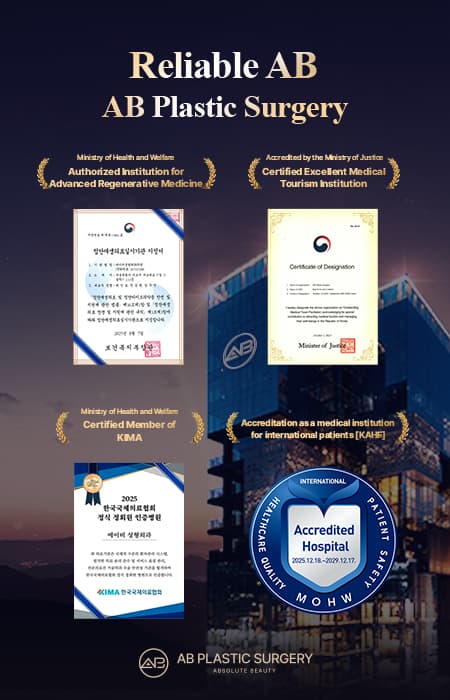
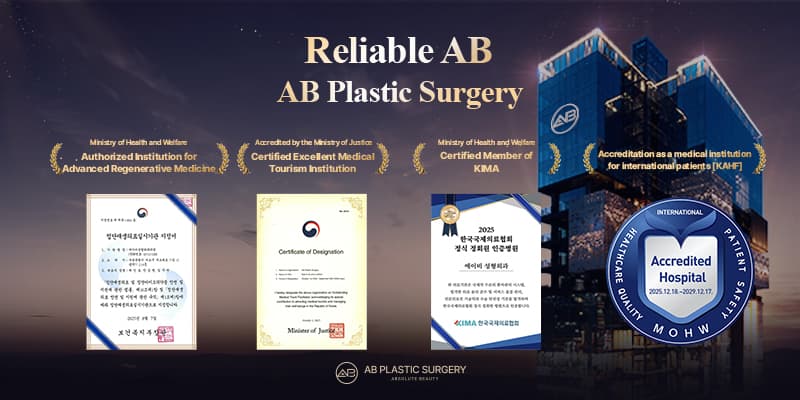
KAHF accreditation |
Korea’s Ministry of Health and Welfare |
Whether a hospital is prepared to treat foreign patients safely, including patient safety management, operating room infection prevention, staff training and emergency response, and hygiene and facilities |
Medical Korea’s official directory of KAHF-accredited hospitals |
|
KIMA full membership |
Korea International Medical Association |
International patient care systems, medical ethics, infection control, and surgical safety reviewed by an industry body |
KIMA’s member hospital listings |
|
2025 Excellent Medical Tourism Institution |
Korea’s Ministry of Justice |
A track record of responsibly receiving and managing international patients |
The Ministry of Justice’s designation announcement |
|
Advanced Regenerative Medicine Institution |
Korea’s Ministry of Health and Welfare |
Facilities, personnel, and standard procedures that meet requirements for regenerative medicine clinical research |
The Ministry of Health and Welfare’s designation record |
In practical terms, KAHF accreditation means the hospital’s systems for foreign patients, including how it explains treatment, manages safety, and responds when something does not go as planned, have been evaluated against a national standard rather than described only by the clinic itself. Accreditation does not guarantee a surgical outcome, but it tells you the hospital operates within a structure that is reviewed. To see these credentials together with AB’s facilities, visit the AB Plastic Surgery introduction page.
Inside the Operating Room: Who Operates and Who Watches
AB Plastic Surgery states that it runs a surgeon real-name system so that the surgeon you consult with is the surgeon who operates, with CCTV installed in all operating rooms and an aseptic operating room system. Anesthesia is managed by on-site board-certified anesthesiology specialists who stay with the patient from before surgery through recovery. AB states that anesthesiology specialists make up 47.1% of its medical staff, compared with 23.1% at hospital-level institutions in the figures it cites, and that patient vital signs are monitored in real time through a central monitoring system during and after surgery.
Results also depend on who designs and performs the surgery. Before your consultation, review the profiles of AB Plastic Surgery’s surgeons to see whose specialties include body contouring and fat grafting.
Screening Before Surgery and Readiness for Emergencies
Before body contouring, AB’s standard pre-operative screening checks for anemia, blood glucose and electrolytes, cardiac function, lung function, liver and kidney function, and infectious diseases, conducted through an in-house examination center with a resident clinical pathologist. The clinic also states that it performs blood crossmatching in house, with results available in about two hours, so compatible blood can be identified quickly if an emergency arises.
AB maintains academic and clinical cooperation with Seoul National University Bundang Hospital, which designated AB as an education cooperation hospital, and has signed cooperation agreements with Hallym University Dongtan Sacred Heart Hospital and Kwangdong Hospital. According to the clinic, AB has recorded zero reported medical accident cases since it opened in September 2020.
Surgeons Who Teach the Technique
Many clinics attend conferences to learn; fewer are invited to teach. AB Plastic Surgery’s surgeons have performed live surgery and lectures for visiting international surgeons through the IFAAS program, and AB was selected as an IFAAS facial contouring lecture institution for three consecutive years. AB surgeons have also chaired sessions and lectured at APS KOREA 2025 and APS KOREA 2026, presented at PRS KOREA 2025, and lectured at the Korean Association of Plastic Surgeons’ 2025 autumn training course. For patients, this kind of peer recognition signals that a clinic’s techniques have been examined by other surgeons, not only by its own marketing.
Body Contouring Cost in Korea and How to Keep Your Results
In short: At AB Plastic Surgery, body contouring starts from $2,890 for a published liposuction package and from $4,490 for abdominal liposuction, while abdominoplasty starts from $10,200. Your final quote depends on the number of areas, the volume of fat, whether skin needs to be removed, and whether the surgery is a revision.
Important: the final cost differs for every patient. The prices below are starting points only. Your actual cost is set after an in-person assessment of your body, your goals, and the surgical plan your surgeon recommends.
|
Procedure |
Starting price (USD) |
What changes the price |
|---|---|---|
|
Liposuction with Handcrafted Technique for Sculpted Results (package) |
$2,890 |
Package scope and treatment area |
|
Abdomen liposuction |
From $4,490 |
Fat volume, extent of removal, and number of areas |
|
Thigh liposuction |
From $5,240 |
Fat volume, extent of removal, and number of areas |
|
Additional area (arms, flanks, love handles, etc.) |
From $2,990 |
Fat volume and number of added areas |
|
Arm lift |
From $2,990 |
Extent of skin and fat removal |
|
Thigh lift |
From $3,740 |
Extent of skin and fat removal |
|
Abdominoplasty |
From $10,200 |
Anatomy, surgical scope, and technique |
|
Fat grafting (hip) |
From $7,480 |
Harvest and grafting volume |
|
Fat grafting (breast) |
From $2,990 |
Harvest and grafting volume |
|
Revision liposuction |
Quoted at consultation |
Correcting a previous result is more complex, typically from 1.5 times the primary fee |
A note on these numbers: they are starting points from AB Plastic Surgery’s current price list, not the total you will pay. Bodies are not priced by the square inch. Two patients asking for “abdominal liposuction” can need very different plans once fat thickness, skin quality, and neighboring areas are examined, so the same procedure can result in a different cost for each person. Your individual quote, confirmed after consultation, is the figure to plan around.
What Is Included for International Patients
AB Plastic Surgery offers a set of complimentary services for patients who proceed with surgery:
-
Interpretation by a medical interpreter
-
CT imaging, a health check-up, and swelling-relief laser treatment
-
Airport pickup
-
Hotel accommodation support for up to five nights
-
A post-operative aftercare kit
These services vary by procedure type and price range and apply only once you decide to have surgery. They cannot be used to reserve a specific surgeon in advance. Confirm which items apply to your plan when you receive your quote. AB’s price inquiry page also includes a calendar planner that lets you map your arrival, consultation, surgery day, follow-up check, and return flight.
Keeping Your After Result
The work of maintaining a body contouring result begins once you are home. These habits have the strongest effect on how long the change lasts:
-
Keep your weight stable. Large gains can enlarge the remaining fat cells, sometimes in untreated areas.
-
Follow the garment schedule. Wearing the compression garment as instructed helps the skin settle smoothly.
-
Return to exercise gradually. Resume activity on your surgeon’s timeline, then keep it regular to support muscle tone.
-
Protect your scars. For skin-removing procedures, follow scar care advice and avoid sun exposure on fresh scars.
Key Takeaways
-
The main before-and-after change is shape and proportion, not weight.
-
Each area changes differently, and connected areas often look best treated together.
-
Your starting body type, especially skin condition, decides whether fat removal or skin removal creates the bigger change.
-
The final result appears at around six months for liposuction and six to twelve months for skin-removing procedures.
-
Verify the surgeon, the anesthesia team, and the hospital’s KAHF accreditation before you book.
Every body starts from a different place, so the most useful before-and-after plan is the one built for yours. To receive a personalized plan, share your goal areas and body measurements for an individual body contouring quote, and AB Plastic Surgery Korea’s team will outline the procedure, expected recovery, and recommended length of stay.

This article is for informational purposes only and does not replace a personal medical consultation.