Title
Documents to Request Before Leaving Korea After Plastic SurgerDate
November 24, 2026Views
9
K-medi
Documents to Request Before Leaving Korea After Plastic Surger
Table of Contents
1. Which Documents to Request Before Leaving Korea and Why
2. Medical Summary or Treatment Certificate
3. Operative Record and Procedure Details
4. Prescription List, Medication Information, and Written Aftercare Instructions
5. Test Results, Imaging Records, and Clinical Photos
6. Frequently Asked Questions About Requesting Documents
7. Identity and Travel-Related Documents: Plastic Surgery Certificate and Treatment Confirmation
8. How to Request Your Documents and Check Them Before Departure
Many international patients plan surgery in Korea carefully, yet only think about paperwork on their final day. This guide covers the documents to request before leaving Korea after plastic surgery: what each one is, when you may need it, and what to check before you leave.
AB Plastic Surgery can provide basic documents such as prescriptions and other paperwork patients commonly need when leaving Korea. This guide is for general information and does not replace your surgeon’s instructions or the requirements of your home country.
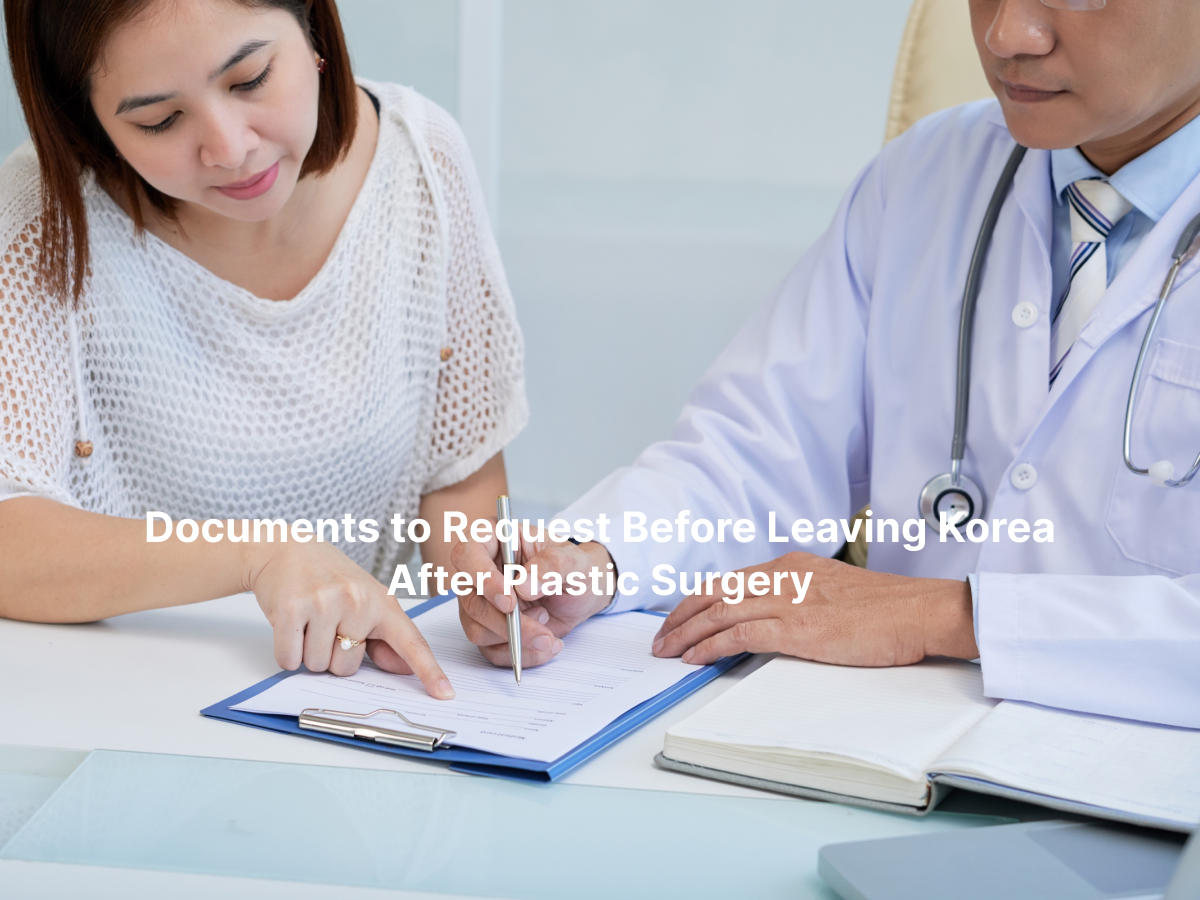
Which Documents to Request Before Leaving Korea and Why
In short: Before you leave, ask for a medical summary, operative record, prescription list, written aftercare instructions, test and imaging records, and, if relevant, a travel identity letter. These are far easier to collect in Korea than from abroad.
Your treatment in Korea ends when you leave the clinic, but your records need to travel with you. Documents turn a procedure that happened in another country, in another language, into information that your own doctor, pharmacist, airline, or insurer can actually use. Requesting them before departure is far easier than trying to obtain them from abroad later.
Four Situations Where Your Documents Are Used
Most requests fall into one of four situations. Knowing which one applies to you makes it easier to decide what to ask for.
-
Continuing care at home: a doctor who did not perform your surgery needs a clear record of what was done.
-
Carrying medication: prescribed medicines are easier to explain when they come with a medication list and a prescription.
-
Identity and travel checks: if your appearance has changed noticeably from your passport photo, supporting paperwork can help explain why.
-
Administrative needs: insurers, employers, or schools may ask for written confirmation of treatment or time away.
Documents at a Glance
The table below summarizes the documents covered in this guide. Each one is explained in its own section, so you can jump to the ones that matter for your situation.
|
Document |
What it is |
Who may ask for it |
|---|---|---|
|
Medical summary or treatment certificate |
A short written summary of your treatment from the treating clinic |
Your doctor at home, insurer, employer, or school |
|
Operative record and procedure details |
The procedure performed, date, anesthesia type, and materials used where applicable |
Your doctor at home, now or for future treatment |
|
Prescription and medication list |
Medication names, doses, and duration |
Your doctor or pharmacist at home; officials if asked |
|
Written aftercare instructions |
Your surgeon’s instructions and follow-up guidance in writing |
You and anyone supporting you at home |
|
Test results, imaging, and clinical photos |
Pre-operative tests, scans, and treatment photos |
Your doctor at home or any future specialist |
|
Plastic surgery certificate or treatment confirmation |
A letter confirming you received treatment at the clinic |
Airline staff or immigration officers, if your appearance differs from your passport photo |
If you are still in the planning stage, our Korea plastic surgery FAQ guide for foreigners covers general preparation. This article focuses only on the paperwork you collect at the end of your stay.
Medical Summary or Treatment Certificate
In short: A medical summary is a short overview of your treatment written by the clinic. It is usually the first document a doctor at home will want to see.
If you request only one document, a medical summary is usually the most useful. It condenses your treatment into a single readable page that any doctor can understand quickly, and it is often the first document a physician at home will want to see.
What a Medical Summary Is
A medical summary, sometimes called a treatment certificate or medical certificate, is a short written statement from the treating clinic describing the care you received. It is written by the medical team rather than by the patient, and it is meant to be read by another healthcare professional or by an organization that needs confirmation of treatment.
What It Typically Includes
The exact format varies between clinics, but a medical summary commonly contains the following.
-
Your name, date of birth, and, where relevant, passport details
-
The name of the clinic and the treating doctor
-
The procedure or procedures performed and the date of treatment
-
A brief note on the type of anesthesia used
-
A short description of the treatment course
-
Follow-up recommendations, where applicable
When You May Need It
A medical summary is most often requested by the doctor who will see you after you return home, particularly if you need a check-up or any question arises about your procedure. Insurers may also ask for written confirmation of treatment, and employers or schools sometimes want documentation that explains an absence. If you are unsure whether you will need one, requesting it is a low-effort precaution.
What to Check Before You Leave
Read the summary before you leave the clinic rather than after you land. Confirm that your name matches your passport, that the procedure names and dates are correct, and that it is written in a language your home doctor can read. Ask whether the document carries the clinic’s official stamp or the doctor’s signature, since many recipients expect one.
Operative Record and Procedure Details
In short: The operative record is the detailed clinical account of your procedure. It matters most if another doctor ever needs your treatment history.
Where a medical summary gives the overview, an operative record gives the detail. It documents what was done during the procedure itself, and it becomes especially valuable if another surgeon ever needs to understand your treatment history.
What an Operative Record Is
An operative record, also called an operation note or surgical record, is the clinical account of your procedure. It is written for medical readers, so it is more technical than a summary. Patients do not need to understand every term, but the document should be complete enough for another doctor to interpret.
What It Typically Includes
Operative records generally cover the details below, though the level of detail differs by procedure.
-
The name of the procedure and the date it was performed
-
The surgical approach or technique, in summary form
-
The type of anesthesia used
-
Materials or devices used during surgery, where applicable, such as implants, sutures, or grafts
-
Any notable observations recorded during the procedure
When You May Need It
This record matters most for future medical care. If you ever consult another doctor about the treated area, consider a revision, or need to explain your history before another procedure, the operative record answers questions that you may not be able to answer from memory. It is also helpful if you receive treatment for an unrelated condition and the doctor needs to know what anesthesia or materials were used.
What to Check Before You Leave
Check that the procedure name and date match what you remember and what appears on your medical summary. If your treatment involved an implant or another device, ask whether details about the material can be included, since this information can be hard to recover later. Keep in mind that not every procedure involves materials of this kind, so the contents will differ from patient to patient.

Prescription List, Medication Information, and Written Aftercare Instructions
In short: Ask for a prescription or medication list, keep medicines in their original packaging, and get your surgeon’s aftercare instructions in writing.
These documents travel with you in a practical sense. They sit alongside the medication in your bag and guide what you do once you are home. AB Plastic Surgery can provide prescriptions and other basic paperwork of this kind, and it is worth asking for all of them together so nothing is missed.
Prescription and Medication List
A prescription or medication list records which medicines you were given, in what dose, and for how long. Ask for the active ingredient names in addition to brand names, since brand names used in Korea may not be recognized elsewhere. A clear list also helps your home doctor or pharmacist avoid duplicating or conflicting with anything you were prescribed.
Be aware that a prescription issued in Korea may not be accepted by a pharmacy in your home country. Whether you can obtain a refill is a decision for your doctor at home, so treat the list as information to share rather than as something you can fill abroad.
Carrying Medication with Your Paperwork
When you travel with prescribed medication, it is generally easier to keep it in its original packaging with the label attached and to carry the matching prescription or medication list with it. Rules about which medicines may be brought into a country differ widely, so check the regulations of your destination, and of any country you transit through, with the relevant customs authority before you fly. Do not assume that a medicine permitted in Korea is permitted everywhere.
Written Aftercare Instructions: What the Document Should Cover
Your surgeon’s aftercare instructions are most useful when they are written down. Spoken advice is easy to forget, especially on a busy discharge day. This section is about the document itself; for guidance on the recovery process, see our guide to recovering from plastic surgery in Korea.
A useful written instruction sheet usually covers the following points.
-
How to care for the treated area, as instructed by your surgeon
-
Activities to avoid and for how long
-
Signs that should prompt you to contact the clinic
-
When follow-up checks are expected
-
How to reach the clinic after you leave Korea
What to Check Before You Leave
Compare the medication list with the medicines you actually received, and make sure the names and doses match. Confirm that the aftercare sheet is in a language you read comfortably, and ask about anything you do not understand before you walk out of the clinic. Always follow your surgeon’s instructions for your own situation.

Test Results, Imaging Records, and Clinical Photos
In short: Ask for digital copies of test results, scans, and clinical photos, and open each file before you leave the clinic to confirm it works.
Test results, scans, and clinical photos form the visual and numerical record of your treatment. They are the documents patients most often forget to ask for, partly because they feel more like background material than paperwork. For a doctor at home, however, they can be the most informative part of your file.
Pre-Operative Tests and Scans
Before surgery, patients typically complete a set of examinations. These may include blood tests and other standard checks, and for some procedures, imaging such as X-rays or CT scans. Not every procedure involves the same tests, so the set of records that exists for you will depend on your treatment. If scans were taken, ask whether copies can be provided, and in what form.
Clinical Photos
Clinical photos are the images taken by the medical team to document your condition before and after treatment. They are a clinical record rather than a marketing material, and they help a doctor at home compare how an area looked at different points. If you want copies for your own records, ask the team at the clinic how this can be arranged.
Digital Copies or Printed Copies
Imaging and photo records are easiest to share when they are digital. Ask whether they can be provided as files that you can store and forward, such as PDF documents or image files. If printed copies are also provided, keep them in your carry-on rather than in checked luggage. Carrying digital and printed versions means you are covered if one fails.
What to Check Before You Leave
Open each file before you leave the clinic and confirm that it displays correctly and carries your name and the date. A file that cannot be opened at home is much harder to fix once you have left Korea.
Frequently Asked Questions About Requesting Documents
In short: Ask early, confirm the language of each document, carry medication in its original packaging, and contact the clinic if anything is missing after you return home.
Can I request my medical records in English before leaving Korea?
Patients can generally ask their treating clinic for documents related to their care, and international patients commonly ask for English versions. AB Plastic Surgery can provide basic documents such as prescriptions and other paperwork patients typically need when leaving Korea. When you make a request, confirm the language of each document, and ask early rather than on your last day.
Do I need a plastic surgery certificate to pass airport immigration?
Not every patient needs one. A certificate is mainly relevant when your appearance has changed noticeably from your passport photo, for example during early healing. It supports your identity but does not replace your passport, and the final decision rests with airline staff and immigration officers. Details about the documents available for your treatment can be explained through a consultation.
Can I take prescribed medication home from Korea?
Patients commonly carry prescribed medication in its original packaging, together with a copy of the prescription or a medication list. Regulations differ by country, so check the rules of your destination and any transit country with the relevant customs authority before you travel.
How long before departure should I ask for my documents?
The earlier the better. Mentioning that you will need documents when you first discuss your plans gives the team time to prepare them, and a reminder during your stay keeps the request on track. At the latest, ask before your final visit so you can review everything before you leave the clinic.
What if I realize I am missing a document after I return home?
Contact the clinic and describe exactly what you need. Have your name, the date of your treatment, and the procedure ready, and ask whether a digital copy can be sent. Collecting documents before you leave is simpler, which is why a final check on your last visit is worthwhile.
Should I share these documents with my doctor at home?
Sharing them is generally helpful, because they give your doctor an accurate picture of your treatment. Your doctor at home decides what care is appropriate for you, and the documents are there to inform that decision rather than to replace a medical assessment.

Identity and Travel-Related Documents: Plastic Surgery Certificate and Treatment Confirmation
In short: A plastic surgery certificate or treatment confirmation is supporting information for identity checks. It does not replace your passport or guarantee how officials will respond.
Identity paperwork is different from medical paperwork. Its purpose is not to inform a doctor but to help an official understand why your appearance may not match your passport photo. For most patients this is a minor point, but for some it is worth preparing for in advance.
Why Passport Photo Differences Come Up
Immigration officers compare the person in front of them with the photo in the passport. After a procedure, temporary swelling, bruising, or bandages can make that comparison harder, and more visible changes to facial features can do the same. Clinics in Korea have been reported to provide a letter, often called a plastic surgery certificate, to help explain such differences to officials.
What a Certificate or Treatment Confirmation Typically Includes
Formats vary, but this kind of letter usually confirms basic facts.
-
The patient’s name and passport number
-
The name of the clinic
-
The period during which the patient was treated in Korea
-
A statement that the patient received a medical procedure at the clinic
What It Can and Cannot Do
A certificate or treatment confirmation is supporting information. It does not replace your passport, it does not guarantee how an airline or immigration authority will respond, and requirements differ by country and carrier. Think of it as helpful context to carry, not as an entry permit. For questions about which documents are available for your treatment, you can ask AB Plastic Surgery through a consultation, where the team can explain the options in detail.
Other Practical Steps for Travel Day
A few simple preparations reduce the chance of delays.
-
Check your airline’s and destination country’s identification requirements in advance.
-
Carry your passport, boarding pass, and a copy of your medical summary together in your hand luggage.
-
Be prepared to remove face coverings or glasses if an officer asks you to.
-
Allow extra time at the airport so that identity checks do not feel rushed.
-
If your appearance continues to differ from your passport photo in the long run, ask your national passport authority how to update it.
How to Request Your Documents and Check Them Before Departure
In short: Request documents in stages, from consultation to your final visit, then check the name, dates, procedure names, signatures, and language before you leave.
Knowing which documents to ask for is half the task. The other half is asking at the right time, in a clear way, and checking what you receive. A short routine at each stage of your stay makes the process manageable.
When to Request Each Document
The timeline below shows a sensible order. It helps you avoid the common situation where every request lands on the final day.
|
Stage |
What to do |
|---|---|
|
At consultation |
Tell the team you will need documents when you leave Korea, and ask which ones you can expect to receive |
|
During your stay |
Confirm the list again and ask about language, format, and digital copies |
|
Before your final visit |
Remind the team of any documents still outstanding so they can be ready |
|
Final visit |
Review every document, check the details, and collect prescriptions and medication together |
If you are preparing questions for your consultation, our list of top 10 questions to ask during a plastic surgery consultation in Korea is a good starting point, and documents are a natural addition to it.
How to Ask Clearly
Specific requests are easier for a medical team to act on than general ones. These examples show the kind of wording that works.
-
“I will be returning to my home country on [date]. Which documents can I receive before I leave?”
-
“Could I have a medical summary in English for my doctor at home?”
-
“Could you provide my prescription and medication list with the active ingredient names?”
-
“Can my test results and photos be sent to me as digital files?”
How to Check Your Documents Before Leaving the Clinic
Once you have the documents in hand, a quick review catches most problems while they are still easy to fix.
-
Name: the spelling matches your passport exactly.
-
Dates: the treatment date and your stay dates are correct.
-
Procedure names: they match what you underwent.
-
Signature or stamp: official documents carry the signature or stamp the recipient may expect.
-
Language: you or your home doctor can read each document.
-
Legibility: printed pages are clear, and digital files open correctly.
Keep Digital and Printed Copies
Store a digital copy of every document in a place you can reach from home, such as a secure cloud folder or your email, and keep the printed originals in your carry-on. If a document is lost in transit or a doctor asks for a copy, having a backup saves a great deal of effort.
Final Pre-Departure Document Checklist
Before you head to the airport, confirm that you have the following.
-
Medical summary or treatment certificate
-
Operative record and procedure details
-
Prescription and medication list, with medication in its original packaging
-
Written aftercare instructions
-
Test results, imaging records, and clinical photos, in digital form where possible
-
Plastic surgery certificate or treatment confirmation, if relevant to your situation
-
Digital backups of everything above
AB Plastic Surgery can provide basic documents such as prescriptions and other paperwork patients commonly need. For more detailed information about the documents available for your treatment, you can ask through a consultation with AB Plastic Surgery, so your paperwork is planned well before departure day.
Written by
AB Plastic Surgery
Updated on
November 24, 2026
This article is for informational purposes only and does not replace a personal medical consultation.