Title
Square Jaw Reduction Surgery Costs in Korea: What You Need to KnowDate
2024-06-10Views
22620
AB Blog
Achieve the Perfect V-Line with Korean Jaw Reduction Surgery
Table of Contents
1. Understanding Square Jaw Reduction Surgery
2. Is Square Jaw Reduction Right for You? Causes, Candidates, and Limits
3. Recovery Process after Square Jaw Reduction Surgery
4. Planning Square Jaw Reduction in Korea as an International Patient
5. Combining Square Jaw Reduction with Other Procedures
6. Costs of Square Jaw Reduction Surgery in Korea
7. How to Choose a Safe Clinic for Square Jaw Reduction in Korea
Square jaw reduction surgery, also known as mandible reduction surgery, is a popular cosmetic procedure in Korea designed to reshape the lower jaw to create a more V-shaped or oval facial contour. This surgery is particularly sought after in Korea, where softer lower-face contours are widely preferred, although the right jawline always depends on each patient’s own goals and facial structure. Understanding the costs, procedure details, recovery process, and the possibility of combining it with other surgeries like chin tip and cheekbone reduction is crucial for anyone considering this transformative procedure.
In short: square jaw reduction cost in Korea at a glance
-
Starting price at AB Plastic Surgery Korea: KRW 7,700,000 (about USD 5,240) for square jaw reduction, based on the clinic’s official price list (pricing date: April 2026, KRW 1,470 = USD 1).
-
How the final fee is set: after an in-person consultation and 3D CT analysis of your jawbone, surgical scope, and any combined procedures.
-
Recovery: the most visible swelling settles over the first 1–2 weeks; the final contour typically takes 3–6 months.
-
Safety baseline: performed under general anesthesia, with a board-certified anesthesiologist on-site and operating-room CCTV at AB Plastic Surgery Korea.

Before-and-after photos show individual patients. Results depend on each person’s bone structure, soft tissue, the procedures performed, and the time elapsed since surgery, and should not be read as a guaranteed outcome. To see more cases organized by procedure, browse AB Plastic Surgery Korea’s before-and-after gallery.
Understanding Square Jaw Reduction Surgery
In short: Square jaw reduction reshapes the angle of the lower jaw (mandible) to narrow a wide lower face. It is performed through incisions inside the mouth under general anesthesia, and it works only when the width comes from bone.
Square jaw reduction surgery involves the surgical contouring of the jawbone to reduce its width and create a more streamlined and aesthetically pleasing shape. This procedure is typically performed under general anesthesia by a qualified maxillofacial or plastic surgeon.
Square Jaw Reduction vs. Jaw Shaving, V-Line Surgery, and Genioplasty
These terms are often used interchangeably online, but they describe different surgical scopes. In this article, they are used as follows.
|
Procedure |
What is changed |
Main purpose |
|---|---|---|
|
Jaw shaving (outer cortex reduction) |
The outer layer of the jawbone is thinned |
Reduces lower-face width seen from the front; often performed as part of square jaw reduction |
|
Square jaw reduction (mandibular angle reduction) |
The angle of the jaw below the ear is contoured or partially removed |
Softens a prominent, outward-flaring jaw angle |
|
V-line surgery |
Contouring extends from the jaw angle along the jaw body toward the chin |
Creates a continuous, tapered line from ear to chin; scope is confirmed at consultation |
|
Genioplasty (chin tip surgery) |
The chin bone is cut and repositioned |
Adjusts chin length, width, or projection |
|
Orthognathic (corrective jaw) surgery |
Upper and/or lower jaw segments are moved to a new position |
Corrects the bite; usually planned with orthodontic treatment and is a different category from aesthetic contouring |
How Jaw Contouring Trends Have Changed in 2025–2026
The goal of jaw reduction has shifted. Rather than making the lower face as small as possible, patients and surgeons increasingly aim for proportion: a jawline that is softer but still defined, and that keeps natural expression and stable soft tissue over time.
-
Less is often more: conservative, proportion-focused reduction is preferred over aggressive bone removal, because excessive reduction can leave the lower face looking hollow or sagging as the patient ages.
-
Diagnosis before surgery: patients are more aware that a wide face can come from muscle or fat, and they expect CT-based analysis rather than a one-size-fits-all V-line.
-
Different goals, different designs: some patients want a slim oval face, while others want to keep a strong, angular jaw and only refine asymmetry or width. Both are valid design goals.
-
Weight-loss medication: with GLP-1 drugs now widely used, more patients are losing facial fat before or around the time of surgery, which changes how the jawline looks and how surgery should be timed (see the next section).
For a broader view of the procedures and decision factors shaping Korean plastic surgery, see AB Plastic Surgery Korea’s 2025–2026 trend report.
How the Surgery is Done
Consultation and Planning
The process begins with a thorough consultation with the surgeon. During this stage, the surgeon assesses the patient’s facial structure, discusses the desired outcome, and plans the surgery. Advanced imaging techniques, such as 3D CT scans, are often used to create a detailed map of the jawbone. At AB Plastic Surgery Korea, pre-operative health screening is carried out in-house with a clinical pathologist on staff, and the clinic can perform blood cross-matching on site so that compatible blood can be prepared quickly if an emergency arises.
Anesthesia
On the day of the surgery, the patient is placed under general anesthesia to ensure comfort and pain-free operation. At AB Plastic Surgery Korea, a board-certified anesthesiologist is on-site and monitors the patient from induction through recovery. The clinic states that anesthesiology specialists make up 47.1% of its medical staff and that it has had zero reported medical accidents since opening in September 2020.
Incision and Bone Shaving
The surgeon makes incisions inside the mouth to access the jawbone, avoiding visible scars. Using specialized surgical tools, the surgeon carefully shaves and reshapes the outer layer of the jawbone to reduce its width and prominence. In some cases, the surgeon might also remove a portion of the bone if necessary.
Contouring and Smoothing
After the initial reduction, the bone edges are smoothed and contoured to achieve a natural look. The surgeon ensures that the jawline is symmetrical and balanced with the rest of the facial features.
Closing the Incisions
The incisions inside the mouth are closed with dissolvable stitches, and the patient is monitored as they wake up from anesthesia.
Is Square Jaw Reduction Right for You? Causes, Candidates, and Limits
In short: Jaw reduction suits people whose lower-face width comes mainly from a prominent jaw angle confirmed on CT. If the width comes from the masseter muscle, fat, or a bite problem, a different treatment is usually more appropriate, and surgery may not be needed at all.
What Makes the Lower Face Look Wide? Matching the Cause to the Treatment
A wide lower face is not always a bone issue. Identifying the cause is the first step, because jaw reduction cannot correct width that comes from muscle or fat.
|
Main cause |
Typical sign |
Options usually considered |
|---|---|---|
|
Prominent jawbone angle |
Angular outline that stays visible even when the jaw is relaxed; confirmed on CT |
Square jaw reduction or V-line surgery |
|
Enlarged masseter muscle |
Bulk at the jaw corner that becomes firmer when clenching |
Muscle-relaxing injections are often considered first; bone surgery does not reduce muscle volume |
|
Fat or sagging soft tissue |
Fullness in the cheeks or along the jawline rather than a bony edge |
Buccal fat removal, facial liposuction, or lifting, depending on the tissue involved |
|
Bite or jaw-position problem |
Teeth do not meet properly; protruding or asymmetric jaw |
Evaluation for corrective jaw surgery rather than contouring alone |
Not every patient wants the same result. Some prefer a softer oval outline, while others want to keep a defined, angular jaw and only refine its proportions. If you want to understand how jawline design is adjusted to different face shapes and preferences, read how AB Plastic Surgery Korea customizes jawline design.
Factors Assessed at Consultation
-
Jawbone width and angle shape on 3D CT
-
Position of the nerve canal running inside the lower jaw, which limits how much bone can be safely reduced
-
Masseter muscle thickness and soft-tissue thickness
-
Facial symmetry, chin shape, and cheekbone width (to judge whether jaw reduction alone will look balanced)
-
Bite and dental condition, general health, current medications, and any previous facial surgery
What Jaw Reduction Cannot Do
-
It does not reduce muscle bulk or facial fat.
-
It does not correct a misaligned bite.
-
Bone reduction is limited by nerve position, so a very wide jaw may narrow less than expected.
-
Some pre-existing asymmetry can remain, because both sides of the face are rarely identical to begin with.
Taking GLP-1 Weight-Loss Medication? Timing and Disclosure
Weight-loss medications such as semaglutide and tirzepatide have become a common part of pre-surgery conversations. They matter for jaw reduction in two ways.
-
Anesthesia safety: the American Academy of Facial Plastic and Reconstructive Surgery notes that these drugs slow stomach emptying, which can raise the risk of aspiration under anesthesia, and that a pause before surgery is commonly recommended. The exact timing is set case by case, so tell both your surgeon and anesthesiologist if you take one.
-
Surgical timing: losing facial fat can make the jaw angle look sharper, or reveal that fat, not bone, was the main cause of width. If you are still losing weight, it is usually better to reassess your face once your weight has stabilized before deciding how much bone to reduce.
If weight loss has left your face looking hollow or loose rather than wide, a different approach may fit better; read about treatment options for Ozempic face.
Possible Risks and How They Are Managed
Like any bone surgery under general anesthesia, square jaw reduction carries risks. Reported risks include swelling and bruising, bleeding or hematoma, infection, temporary or, rarely, lasting numbness of the lower lip and chin, asymmetry, irregular contour, and soft-tissue sagging after bone volume is reduced. Pre-operative CT planning, careful surgical technique, and close post-operative monitoring are used to lower these risks; the surgeon should explain how each one applies to your anatomy. For more surgeon-written explanations of facial bone surgery, read AB Plastic Surgery Korea’s medical column.
The recovery period following square jaw reduction surgery is crucial for achieving the best results. Here’s a detailed look at what to expect during recovery.
Recovery Process after Square Jaw Reduction Surgery
In short: Recovery happens in three stages: visible swelling and a soft diet in the first 1–2 weeks, gradual return to normal eating and routine at 3–6 weeks, and a settled final contour at about 3–6 months. Returning to work and seeing your final result are two different milestones, and timing varies with the surgical scope and each patient’s healing.

This case shows jaw reduction combined with chin tip surgery, so the change should not be read as the result of jaw reduction alone.
Initial Recovery (1-2 Weeks)
-
Swelling and Bruising: Significant swelling and bruising are common in the first week. The use of cold compresses and prescribed medications can help manage these symptoms.
-
Diet: A soft or liquid diet is recommended to avoid stressing the jaw. Foods that require minimal chewing are ideal.
-
Pain Management: Pain and discomfort can be managed with prescribed painkillers. It’s important to follow the surgeon’s instructions regarding medication.
-
Oral Hygiene: Because the incisions are inside the mouth, keeping the mouth clean as instructed helps protect the healing wounds.
Mid-Term Recovery (3-6 Weeks)
-
Reduced Swelling: Swelling begins to subside, and the initial results of the surgery become more apparent.
-
Gradual Diet: Patients can slowly reintroduce solid foods as tolerated.
-
Follow-Up Visits: Regular follow-up appointments with the surgeon are essential to monitor healing and address any concerns.
Long-Term Recovery (3-6 Months)
-
Final Results: It may take several months for the swelling to completely subside and for the final results to be visible.
-
Normal Activities: Most patients can resume normal activities within a few weeks, but strenuous activities and heavy lifting should be avoided for at least a month.
Returning to Work vs. Seeing the Final Result
|
Milestone |
General timeframe |
What it means |
|---|---|---|
|
Soft diet |
First 1–2 weeks |
Minimal chewing to protect the jaw and incisions |
|
Desk work and daily routine |
Within a few weeks for most patients |
Some swelling is still visible; return depends on comfort and how public-facing your job is |
|
Exercise and heavy lifting |
Avoid for at least a month |
Resume only after your surgeon confirms healing |
|
Final contour |
About 3–6 months |
Residual swelling resolves and the soft tissue settles over the new bone shape |
Recovery can take longer when several bones are contoured at once, when there is more soft-tissue swelling, or when the patient has had previous facial surgery. For a broader look at how recovery differs across facial contouring procedures, see the facial contour surgery recovery guide.
When to Contact Your Clinic Right Away
Contact your clinic, or seek local emergency care if you are already home, if you notice:
-
Swelling that suddenly increases on one side, or a firm, tense swelling
-
Bleeding from inside the mouth that does not stop with gentle pressure
-
Fever, pus, a foul taste, or pain that worsens after it had been improving
-
Difficulty breathing or swallowing
Planning Square Jaw Reduction in Korea as an International Patient
In short: Build your trip around three fixed points: consultation and CT before surgery, the post-operative check before you fly, and a clear plan for follow-up after you return home. Keep flexible buffer days rather than booking the tightest possible schedule.
Korea has become one of the busiest medical travel destinations in the world. According to the Ministry of Health and Welfare (April 2026), foreign patients visiting Korea passed 2 million for the first time in 2025, up from 1.17 million the year before, with plastic surgery accounting for 11.2% of cases. Patients from the United States rose by about 70% to a record 173,000. With demand at this level, careful planning matters more than ever.
Before You Travel
-
Online pre-consultation: share clear front and side photos so the team can give an initial opinion, but expect the final plan only after an in-person CT.
-
Medications: list all prescriptions and supplements, including any weight-loss medication, and confirm what to pause before surgery.
-
Visa: AB Plastic Surgery Korea was designated a 2025 Excellent Medical Tourism Attraction Institution by Korea’s Ministry of Justice, which allows eligible patients to apply for a medical e-visa through a streamlined process.
During Your Stay in Korea
-
Before surgery: allow time for the in-person consultation, 3D CT, and pre-operative health screening before the operation date.
-
Before your flight home: attend the post-operative check your surgeon schedules and confirm that you are cleared to fly. Ask for a written summary of the procedure performed and your medication instructions.
-
Buffer days: leave flexibility in your return flight in case swelling or follow-up timing requires a longer stay.
After You Return Home
AB Plastic Surgery Korea provides a personal patient manager for follow-up questions and operates a 24-hour emergency call line for post-operative concerns. Keep your surgical summary on hand in case you need to see a local doctor, and send progress photos when your coordinator requests them so the team can check your healing remotely.
Combining Square Jaw Reduction with Other Procedures
In short: Chin tip surgery or cheekbone reduction is added only when the CT and facial analysis show that jaw reduction alone would leave the face unbalanced. If the chin and cheekbones already fit the new jawline, combining procedures adds cost, surgical time, and recovery without a clear benefit.
To achieve a more harmonious facial appearance, square jaw reduction surgery can be combined with other procedures such as chin tip surgery and cheekbone reduction surgery. The decision should be based on facial proportions rather than on a preset package. For a detailed look at when combined contouring makes sense and when it does not, read our guide to combining facial contouring procedures.
Chin Tip Surgery
Chin tip surgery, or genioplasty, involves reshaping the chin to improve facial balance and harmony. This procedure can enhance the results of jaw reduction surgery by further refining the jawline and creating a more V-shaped facial contour.
Chin Tip Surgery Procedure
In bone genioplasty, the surgeon makes an incision inside the mouth, cuts the chin bone, and moves it forward, backward, shorter, or narrower before fixing it in place. A chin implant is a separate option: a pre-shaped implant is placed over the existing bone through an incision inside the mouth or under the chin, adding projection without cutting the bone. Which approach fits depends on whether the chin needs to be shortened or narrowed (bone surgery) or mainly needs more forward projection. For a full explanation of methods and costs, read the genioplasty guide.
When It Is Considered and When It Is Not Needed
-
Usually considered: when the chin looks long, wide, or recessed relative to the narrowed jaw, so the lower face would not form a smooth line after jaw reduction.
-
Usually not needed: when the chin length and projection already match the planned jawline.
Recovery after Chin Tip Surgery
Similar to jaw reduction surgery, the recovery involves swelling, bruising, and a soft diet initially. Full recovery can take several weeks.

Cheekbone Reduction Surgery
Cheekbone reduction surgery, or zygoma reduction, reduces the prominence of the cheekbones to create a softer facial appearance. This procedure can be particularly beneficial for individuals with wide or prominent cheekbones that detract from the overall facial harmony.
Cheekbone Surgery Procedure
The surgeon makes incisions inside the mouth and/or along the hairline to access the cheekbones. The bones are then reshaped or repositioned to achieve a more balanced look.
When It Is Considered and When It Is Not Needed
-
Usually considered: when the widest point of the face is the cheekbones, so a narrower jaw would make them look even more prominent.
-
Usually not needed: when cheekbone width is already in proportion, or when the cheek area looks full because of soft tissue rather than bone.
Recovery after Cheekbone Surgery
Recovery involves managing swelling and bruising, with a similar timeline to jaw reduction surgery. Patients are advised to follow a soft diet and avoid strenuous activities during the initial recovery period.
Soft-Tissue Sagging After Bone Reduction
When bone volume is reduced, the skin and soft tissue that it supported need to adapt. In patients with thinner skin or early signs of aging, this can show as looseness along the jaw or cheeks. Current practice therefore pays more attention to soft-tissue support: limiting reduction to what the face needs, preserving attachments where possible, and, in selected patients, planning lifting at the same time or later. Ask your surgeon how your skin quality and age affect this risk.
Costs of Square Jaw Reduction Surgery in Korea
In short: At AB Plastic Surgery Korea, square jaw reduction starts at KRW 7,700,000 (about USD 5,240). This is a starting price, not an average. The final quote depends on your CT findings, the surgical scope, and whether chin or cheekbone surgery is added, and it is confirmed only after an in-person consultation.
Square jaw reduction surgery in Korea involves several costs, including surgeon's fees, anesthesia, hospital or clinic fees, and medical tests and imaging. The surgeon's fees vary based on their experience and reputation. General anesthesia is required for the procedure, adding to the overall cost, as do the fees for using the surgical facility and receiving pre- and post-operative care. Additionally, pre-surgical tests and imaging are necessary. For the exact prices you can contact AB Plastic Surgery Korea’s customer center for a personalized quote.
Facial Contouring Surgery Starting Prices at AB Plastic Surgery Korea
The overall cost of square jaw reduction surgery in Korea depends on the surgical technique, facial bone structure, and whether additional contouring procedures are combined.
The prices below are AB Plastic Surgery Korea’s own starting prices, not averages for Korea as a whole. Prices at other clinics may differ.
|
Procedure |
Surgical scope |
Starting price (KRW) |
Approx. USD |
|---|---|---|---|
|
Square jaw reduction |
Jaw angle contouring, with outer cortex reduction if needed |
7,700,000~ |
$5,240~ |
|
V-line facial contouring |
Lower-face line contouring; exact scope confirmed at consultation |
5,500,000~ |
$3,740~ |
|
Chin tip surgery (genioplasty) |
Chin bone repositioning |
7,700,000~ |
$5,240~ |
|
Cheekbone (zygoma) reduction |
Cheekbone reshaping or repositioning |
7,700,000~ |
$5,240~ |
|
3-set facial contouring |
Combined contouring of three areas; combination confirmed at consultation |
23,000,000~ |
$15,650~ |
|
Buccal fat removal |
Soft-tissue option when cheek fullness, not bone, causes width |
2,000,000~ |
$1,360~ |
|
Revision facial contouring |
Correction of a previous contouring surgery |
Quoted case by case; often about twice the primary fee or more, depending on difficulty |
|
Important: Surgery costs may vary depending on individual facial anatomy, CT scan analysis, surgical complexity, hospitalization period, and personalized treatment planning. Because every facial structure is different, the exact cost can only be determined after a detailed consultation and CT analysis with the surgeon. USD figures are approximate conversions and may change with the exchange rate.
Compare V-line and facial contouring surgery costs in Korea →
Additional Costs
Additionally, there are potential costs that may arise post-surgery. Because what is bundled into a quote can differ between procedures and price tiers, ask your coordinator to confirm each item below in writing before paying a deposit.
|
Item |
What to ask |
|---|---|
|
General anesthesia |
Is the anesthesiologist’s fee included in the surgical fee? |
|
3D CT and pre-operative tests |
Are imaging and blood tests included or charged separately? |
|
Hospital stay |
Is an overnight stay recommended for your scope, and is it included? |
|
Medications |
Are pain relievers and antibiotics included? |
|
Follow-up care |
How many follow-up visits are included, and are extra visits or treatments charged? |
|
Interpreter, transport, accommodation |
Which of these are provided for your procedure and price tier? |
While follow-up consultations are usually included in the initial fee, extra visits or treatments may incur additional charges. If the surgery is combined with other procedures such as chin tip surgery or cheekbone reduction, the overall costs will increase, and each added procedure is reflected in your quote.
Medical Tourism Packages
For international patients, many Korean clinics offer medical tourism packages that include:
-
Surgery Costs: All-inclusive surgery fees.
-
Accommodation: Hotel stays for the recovery period.
-
Transportation: Airport transfers and transportation to and from the clinic.
-
Interpreter Services: Assistance with language barriers.
At AB Plastic Surgery Korea, patients who decide to proceed with surgery may receive the following complimentary services. The services provided differ by procedure type and price range, and they cannot be used to pre-select a specific surgeon.
-
Interpretation by medical-specialist interpreters
-
Free CT imaging, health screening, and swelling-relief laser treatment
-
Airport pickup
-
Hotel accommodation support for up to five nights
-
A post-operative aftercare kit
Frequently Asked Questions About Square Jaw Reduction Cost
How much does square jaw reduction cost in Korea?
At AB Plastic Surgery Korea, square jaw reduction starts at KRW 7,700,000 (about USD 5,240, pricing date April 2026). The final fee is set after a consultation and 3D CT, and increases if chin or cheekbone surgery is added.
Will jaw reduction slim my face if the width comes from muscle?
No. Bone surgery does not reduce the masseter muscle. When muscle is the main cause, muscle-relaxing injections are usually discussed first. The consultation and CT help distinguish bone, muscle, and fat.
Can I have jaw reduction while taking a GLP-1 weight-loss medication?
Tell your surgeon and anesthesiologist before booking. These medications slow stomach emptying, so a pause before general anesthesia is commonly recommended, and if you are still losing weight it is usually better to reassess your face once your weight is stable.
How long should I stay in Korea?
Plan for the consultation and pre-operative tests, the surgery, and the post-operative check your surgeon schedules before you fly. Confirm your clearance to fly before booking a fixed return date, and keep buffer days in case your follow-up needs to be adjusted.
Is general anesthesia for jaw surgery safe?
No surgery under general anesthesia is risk-free. At AB Plastic Surgery Korea, a board-certified anesthesiologist stays on-site throughout, operating rooms are monitored by CCTV, and an emergency response system is in place. Ask your surgeon how your health history affects your anesthesia plan.
How to Choose a Safe Clinic for Square Jaw Reduction in Korea
In short: Compare clinics on what you can verify: government accreditation, who is in the operating room, how emergencies are handled, and whether the surgeons have a recognized academic record in facial contouring. Price alone does not show any of these.
For an international patient, the bigger risk is often not the operation itself but what happens if a problem arises after it, in a country where you do not speak the language. Comparing clinics only on price leaves this out. The following are the systems and credentials AB Plastic Surgery Korea states it has in place.
National Accreditation and Memberships
-
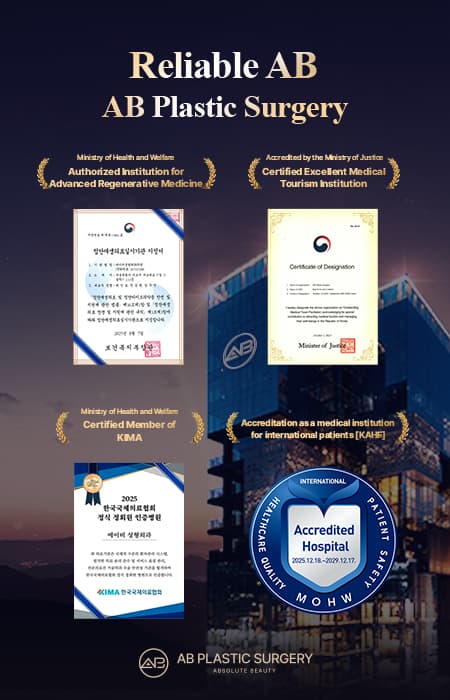
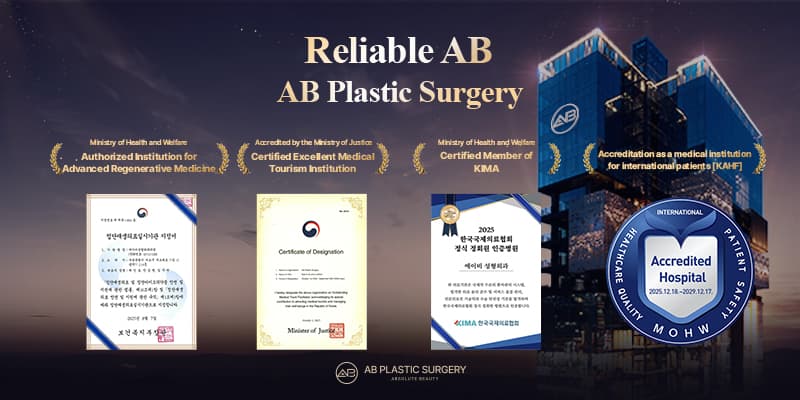
KAHF accreditation (Accreditation as a medical institution for international patients): a Ministry of Health and Welfare program that evaluates how a clinic manages patient safety, operating-room infection prevention, staff training and emergency response, and hygiene and facilities when treating international patients. AB Plastic Surgery Korea received the certification at MEDICAL KOREA 2026, with accreditation valid through December 2029. For a patient, this means post-operative care and incident response have been reviewed against national standards rather than left to a private agreement between clinic and patient.
-
KIMA full membership: AB Plastic Surgery Korea is a registered full member of the Korea International Medical Association, which reviews international patient service systems, medical quality management, and surgical safety.
-
Excellent Medical Tourism Attraction Institution (2025): designated by the Ministry of Justice after review of factors including illegal-stay rates, patient volume, and visa refusal rates.
-
Advanced Regenerative Medicine Institution: the clinic’s stem cell center has been designated by the Ministry of Health and Welfare as an institution that may conduct advanced regenerative medicine clinical research.
Operating-Room Safety Protocols
-
A board-certified anesthesiologist on-site for every procedure under anesthesia, with real-time monitoring
-
Operating-room CCTV and a surgery real-name system, so patients can confirm who performed their operation
-
In-house blood cross-matching and university-hospital-level emergency equipment
-
A 24-hour emergency call line after discharge
-
Zero reported medical accidents since opening in September 2020, according to the clinic
To learn more about the clinic’s history, facilities, and certifications, read the introduction to AB Plastic Surgery Korea.
Surgeon Experience and Academic Activity in Facial Contouring
Facial bone surgery depends heavily on the surgical team’s depth of experience, especially when several bones are contoured together. At AB Plastic Surgery Korea:
-
The clinic was appointed an education cooperation hospital of Seoul National University Bundang Hospital in 2023, and its surgeons received collaborating clinical faculty positions in facial contouring, rhinoplasty, and eye surgery.
-
AB Plastic Surgery Korea hosts IFAAS training programs in which overseas surgeons observe its techniques and live surgery, and the clinic states that its facial contouring team has been selected as an IFAAS facial contouring lecturer for three consecutive years. In other words, its surgeons teach these techniques to other surgeons, not just learn them.
-
AB surgeons have presented at APS KOREA 2025 and APS KOREA 2026, the international congress of the Korean Society for Aesthetic Plastic Surgery.
To check each surgeon’s specialty and background before your consultation, meet the AB Plastic Surgery Korea surgical team.
Sources and Price Reference
-
Prices: AB Plastic Surgery Korea official price list (pricing date April 2026; KRW 1,470 = USD 1)
-
Foreign patient statistics: Ministry of Health and Welfare, Republic of Korea (released April 2026)
-
GLP-1 medication and surgery guidance: American Academy of Facial Plastic and Reconstructive Surgery (AAFPRS)
-
KAHF accreditation: Ministry of Health and Welfare, Republic of Korea
-
Excellent Medical Tourism Attraction Institution designation: Ministry of Justice, Republic of Korea
-
Full membership: Korea International Medical Association (KIMA)
-
Safety record and staffing figures: as stated by AB Plastic Surgery Korea
Square jaw reduction surgery in Korea is a highly specialized procedure that can significantly enhance facial aesthetics by creating a more refined and balanced jawline. Understanding the details of the procedure, recovery process, and costs involved is essential for anyone considering this surgery. Additionally, combining jaw reduction with chin tip surgery and cheekbone reduction can provide a comprehensive approach to achieving the desired facial contour when your facial proportions call for it.
When comparing the costs of square jaw reduction surgery in Korea, look at what each quote includes and which safety systems stand behind it, not just the headline price. The proficiency of Korean surgeons is at an exceptional level, often utilizing advanced surgical techniques for optimal results. By thoroughly researching and selecting a reputable clinic and surgeon, patients can ensure they achieve the best possible outcomes from their surgery. For more guides on facial contouring, recovery, and medical travel, explore the AB Plastic Surgery Korea blog.
Let our consultants guide you through the process. Contact AB Plastic Surgery Korea today.

Written by
AB Medical Editorial Team
Medically reviewed by
Updated on
October 29, 2026
This article is for informational purposes only and does not replace a personal medical consultation.