Title
Why Choose 3-Type Facial Contouring Over Other Facial Contouring SurgeriesDate
2024-07-11Views
11000
AB Blog
Personalized Facial Contouring in Korea: 3-Types Face Contouring Surgery
Table of Contents
1. What Is 3-Types Face Contouring, and Do You Need All Three?
2. Cheekbone Reduction (AB 4D Fix Cheek Reduction)
3. Square Jaw Reduction (Square Jaw All Cut 4 Types)
4. Chin Tip Surgery
5. Recovery After 3-Types Face Contouring: A Stage-by-Stage Guide
6. Cost of 3-Types Face Contouring
7. Frequently Asked Questions About 3-Types Face Contouring in Korea
8. Why Choose 3-Types Face Contouring Plastic Surgery?
3-types face contouring combines cheekbone reduction, square jaw reduction, and chin tip surgery within one treatment plan. Planning these areas together allows the surgeon to assess how changes to one region may affect overall facial proportions. However, not every patient needs all three procedures; the recommended combination depends on individual anatomy, goals, and surgical risk.
This combination is also called 3-type facial contouring, “3-set,” or “3-point” facial contouring. In this article, we use “3-types face contouring” for the combined plan. Below, AB Plastic Surgery Korea explains how the three areas relate to one another, what each procedure can and cannot change, how recovery progresses when the procedures are combined, and how to read a facial contouring quotation. For an overview of every contouring technique, see our facial contour surgery guide.
What Is 3-Types Face Contouring, and Do You Need All Three?
How the Three Areas Relate to One Another
Facial width and shape are defined largely by bone. The cheekbones (the zygomatic body and arch) set the width of the mid face. The mandibular angle and lower jaw body set the width of the lower face. The chin determines the length, width, and projection at the bottom of the face.
Because these areas are seen together, changing one affects how the others appear. Narrowing only the lower jaw can make prominent cheekbones look more noticeable. Reducing only the cheekbones can leave a wide lower face looking even wider by comparison. The length and projection of the chin also change how the jawline reads from the front and in profile. For this reason, surgeons usually evaluate all three areas together, even when the final plan includes only one or two procedures.
Why Some Areas Are Better Left Unchanged
Facial contouring does not produce a better result simply by removing more bone. Bone that has been removed does not grow back, and every additional area adds surgical time, swelling, and recovery. If an area is already in proportion with the rest of the face, changing it adds risk without a clear benefit. Overcorrection is one of the main reasons patients are dissatisfied after contouring, as explained in our guide on how to avoid botched facial contouring results.
Soft tissue matters as well. Skin elasticity, fat thickness, and muscle volume all influence how a bone change shows on the surface. A patient with thin skin and good elasticity may see a different result from a patient with thicker soft tissue, even after a similar bone reduction.
One, Two, or Three Areas: Questions to Review at Consultation
The table below is not a self-diagnosis tool. It lists the questions a surgeon and patient typically review when deciding how many areas to include.
The final plan is decided after an in-person examination, including 3D-CT imaging to assess bone thickness, asymmetry, and nerve position.
Cheekbone Reduction (AB 4D Fix Cheek Reduction)
The first type of surgery, cheekbone reduction, is designed for individuals whose prominent cheekbones make the mid face look wide or angular. AB Plastic Surgery uses its 4D Fix technique to reposition the most protruding points of the cheekbone body and arch inward, aiming for a smoother contour from the front and oblique views.
The repositioned bone is stabilized with titanium double fixation. Fixation is intended to keep the bone segments stable while they heal and to lower the risk of non-union. Delayed bone healing and non-union remain recognized complications of cheekbone reduction, so fixation is one part of risk management, alongside careful surgical planning and follow-up.
The technique also re-suspends the soft tissues attached to the cheekbone, including the skin, fascia, and retaining ligaments, to help limit downward displacement of the cheek after the bone is narrowed. Whether buccal fat removal should be added depends on what is causing the fullness. When deep cheek fat is excessive and visibly protruding, removing part of it may help reduce the possibility of sagging. When the fullness comes mainly from thick subcutaneous fat or reduced skin elasticity, sagging can still occur, and other measures such as lifting or facial liposuction may need to be considered. Buccal fat removal also carries its own risks, including over-hollowing of the cheek, so it is decided case by case.

What Cheekbone Reduction Can and Cannot Change
What it can address: a wide mid face, protrusion of the cheekbone body when viewed from an angle, and an outward-flaring cheekbone arch seen from the front.
What requires separate evaluation: cheek fullness caused mainly by soft tissue, skin laxity, and mid-face volume loss. Temporary numbness of the cheek or upper lip can occur after surgery and usually improves gradually.

Square Jaw Reduction (Square Jaw All Cut 4 Types)
The second type of surgery in the 3-types face contouring approach is square jaw reduction, which targets a wide, angular lower face that gives the face a boxy appearance. At AB Plastic Surgery, the 4-type cut technique can address four components in a single surgery: the mandibular angle and lower jaw border, the outer cortical bone of the lower jaw, deep cheek fat, and the masseter muscle.
The procedure uses a long L-curve excision that extends from below the ear toward the front of the lower jaw, aiming for a continuous contour without a secondary angle. The wide, thick outer cortical bone is reduced to slim the jawline from the front view. Where deep cheek fat is excessive, part of it may be removed, and where the masseter muscle is well developed, reducing it can add to the narrowing effect. Each of these steps is included only when the examination shows a reason for it.
The lower jaw also contains the inferior alveolar nerve, which provides sensation to the lower lip and chin. Its position, confirmed on 3D-CT before surgery, limits how much bone can be removed. When the nerve sits low, the amount, range, and angle of cortical bone reduction are adjusted to achieve the best possible result within the patient’s anatomy.

What Square Jaw Reduction Can and Cannot Change
What it can address: a wide lower face seen from the front, a prominent jaw angle in profile, and lower-face width related to a developed masseter muscle. Unlike fillers, which add volume, bone reduction changes the underlying width of the jaw; see jawline surgery vs fillers for a comparison.
What requires separate evaluation: bite problems and jaw position, which are treated with orthodontics and orthognathic surgery rather than contouring alone. Some angle is usually preserved to keep a natural side profile, and the ideal amount differs by face shape, as covered in our article on customized jawline design for different face shapes. In patients with reduced skin elasticity, loose skin may become more noticeable after bone reduction. Temporary numbness of the lower lip and chin is possible.
Chin Tip Surgery
The third type of surgery, chin tip surgery, focuses on the chin, a key element of a well-proportioned face. In this procedure, the chin bone is cut, repositioned, and fixed, allowing its length, width, and projection to be adjusted. The plan is personalized to each patient so that the chin connects naturally with the jawline and the rest of the face.
By addressing common concerns such as a short, wide, or recessed chin, the procedure aims to bring the chin into proportion with the overall face. The bone edges are smoothed inside and out to avoid step deformities and secondary angles along the jawline.

What Chin Tip Surgery Can and Cannot Change
What it can address: chin length, chin width, and chin projection, as well as how the chin connects to the jawline.
What requires separate evaluation: a severely recessed lower jaw combined with a bite problem, which may require orthognathic surgery. For a mildly recessed chin, a chin implant may be an alternative. Methods, costs, and recovery for chin surgery alone are explained in our genioplasty guide. Temporary numbness of the lower lip and chin can occur and usually improves over time.

Recovery After 3-Types Face Contouring: A Stage-by-Stage Guide
Each procedure has its own recovery pattern. When the procedures are combined, however, recovery generally follows the most extensive part of the surgery, so the timeline for a single chin surgery should not be applied to a three-area plan. The stages below reflect general medical guidance; your surgeon will set your individual schedule based on your surgery and healing progress.
Planning Your Stay in Korea
International patients should plan enough time in Korea to attend postoperative checks before flying home. If this is your first surgery abroad, our first-time medical tourism guide for Korea covers the overall preparation. Many patients plan for around two weeks, but the surgeon decides when it is appropriate to travel based on swelling, wound condition, and progress at follow-up visits. Because final results take months, it is also helpful to plan how follow-up questions will be handled after you return home.
Aftercare at Home
Common aftercare measures include keeping the head elevated, using cold compresses in the early days, following a soft diet, and maintaining careful oral hygiene, since incisions are usually made inside the mouth. Smoking and alcohol should be avoided because they can interfere with healing. At AB Plastic Surgery, postoperative care for facial contouring patients includes Smartlux LED treatment for swelling and bruising, high-frequency care to support circulation, and a home care kit selected by the medical team.
Contact the clinic promptly if you notice swelling that suddenly increases on one side, persistent bleeding, fever, or worsening pain. AB Plastic Surgery operates a 24-hour emergency call system for facial contouring patients.
Cost of 3-Types Face Contouring
The cost of 3-types face contouring plastic surgery can vary depending on several factors. Key influences on the overall price include:
-
the number of areas treated and the techniques required for each area
-
facial bone structure, bone thickness, and asymmetry
-
revision history, as revision contouring is generally more complex
-
additional procedures such as buccal fat removal or soft tissue contouring
Starting Prices for Facial Contouring at AB Plastic Surgery Korea
These are starting prices, not averages. Prices are set in Korean won, and USD amounts are approximate conversions at about KRW 1,470 per USD 1, so the actual USD amount depends on the exchange rate at the time of payment. Prices may change after the review date shown above. Starting prices for other procedures are listed in our 2026 plastic surgery cost guide for Korea.
The 3-set price is quoted as a single combined plan rather than the sum of three separate procedures. Your final quotation may be higher than the starting price, depending on your anatomy, the techniques required, and any additional procedures.
What to Confirm in Your Quotation
-
Which procedures and techniques are included for each area
-
Whether anesthesia, preoperative tests, 3D-CT, medications, and follow-up visits are included
-
Whether additional procedures, such as buccal fat removal or masseter reduction, are priced separately
-
Whether VAT is included and how the USD amount is calculated
-
The clinic’s policy on revision surgery and how long the quotation remains valid
Depending on the procedure and price range, AB Plastic Surgery also provides complimentary services for patients, which may include medical interpretation, CT imaging, a health check, swelling-relief laser treatment, airport pickup, up to five nights of hotel accommodation, and an aftercare kit. These services apply once surgery is confirmed, and eligibility differs by procedure.
Because every patient requires a personalized surgical approach, an accurate quotation can only be provided after a professional consultation and facial analysis.
→ Check Your Personalized Facial Contouring Cost & Surgery Schedule in Korea

Frequently Asked Questions About 3-Types Face Contouring in Korea
How much does 3-types face contouring surgery cost in Korea?
At AB Plastic Surgery Korea, 3-set facial contouring surgery starts from KRW 23,000,000 (approximately USD 15,650). The final cost depends on facial bone structure, asymmetry, revision history, and whether additional procedures are included. An accurate quotation requires a consultation and facial analysis, including CT imaging.
Do I need all three facial contouring procedures?
Not necessarily. 3-types face contouring combines cheekbone reduction, square jaw reduction, and chin tip surgery, and it is typically considered when the mid face, lower face, and chin each contribute to the concern. Many patients need only one or two procedures. Each area included in the plan should have its own reason for correction.
How is 3-types face contouring different from V-line surgery?
V-line surgery generally focuses on the lower face, reducing the mandibular angle and lower jaw while reshaping the chin to create a tapered jawline. 3-types face contouring adds cheekbone reduction for the mid face. If the cheekbones are not prominent, a lower-face plan may be enough. Because clinics use these terms differently, confirm which procedures are included in any plan you are offered.
How long is the recovery period after 3-types face contouring surgery?
Swelling usually peaks in the first few days, and many patients return to light daily activities after about two weeks, although some need longer after three-area surgery. A soft diet and exercise restrictions continue for several weeks. Residual swelling and numbness improve over several months, and the final contour is generally assessed around six months or later.
Can facial contouring correct bite problems?
No. Facial contouring reshapes the outer contour of the cheekbones, lower jaw, and chin, but it does not move the tooth-bearing parts of the jaws. Bite problems such as an underbite, overbite, or open bite are generally treated with orthodontics and orthognathic surgery. Orthodontic treatment after facial contouring is generally possible about one month after surgery, once initial recovery has progressed, but timing should be confirmed with an orthodontist.
What can an online consultation assess, and what requires an in-person examination?
An online consultation based on photos can help clarify:
-
your general face shape and goals
-
which areas are likely to be discussed
-
a preliminary cost range and travel schedule
An in-person examination is needed to:
-
assess bone thickness, asymmetry, and nerve position on 3D-CT
-
evaluate skin and soft tissue
-
complete preoperative health tests
-
confirm the final surgical plan and quotation
If test results show that surgery is not safe, the plan may change or surgery may not proceed.
Why Choose 3-Types Face Contouring Plastic Surgery?
Comprehensive Facial Harmony
The 3-types face contouring approach allows cheekbone reduction, square jaw reduction, and chin tip surgery to be planned as one design rather than as separate changes. When the proportions between mid-face width, lower-face width, and chin length are assessed together, the treated areas can be designed to connect smoothly. The goal is a balanced face, not the smallest possible face.
Personalized and Tailored Approach
Each procedure is tailored to the individual’s anatomy and goals. A personalized plan identifies which areas genuinely contribute to the concern, such as prominent cheekbones, a wide jawline, or a disproportionate chin, and leaves well-proportioned areas unchanged. This approach supports a natural, individualized result and avoids unnecessary surgical scope.
Safety System for Facial Contouring at AB Plastic Surgery
Facial contouring involves bone surgery under general anesthesia, so the safety system matters as much as surgical technique. At AB Plastic Surgery Korea, facial contouring is supported by the following measures:
-
Preoperative screening: an in-house examination center with on-site clinical pathologists assesses anemia, blood glucose and electrolytes, cardiac function, lung function, liver and kidney function, and infectious diseases, alongside 3D-CT imaging.
-
Anesthesia care: a board-certified anesthesiologist is on site, with 1:1 anesthesia care during surgery, a central monitoring system, and end-tidal CO₂ monitoring.
-
Emergency preparedness: an uninterruptible power supply (UPS), a defibrillator, and dantrolene, the treatment for malignant hyperthermia, are kept on site.
-
Operating room transparency: CCTV is installed in all operating rooms, and under the real-name surgery policy, the designated surgeon oversees care from consultation through recovery.
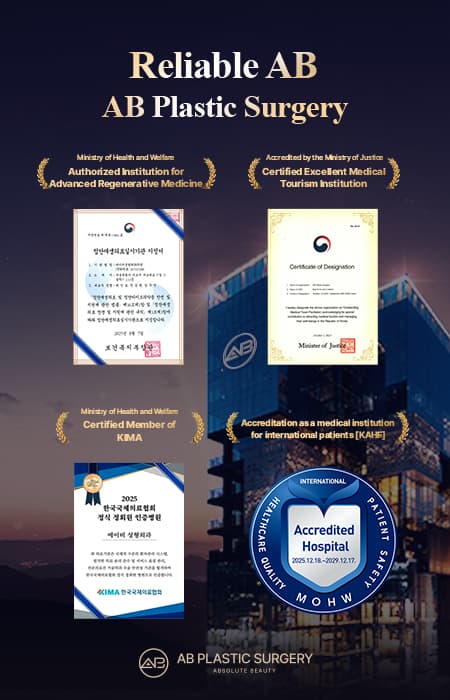
AB Plastic Surgery Korea is also accredited under Korea’s Accreditation as a medical institution for international patients (KAHF). For international patients, this means the hospital’s systems for communication, explanation of treatment, aftercare, and handling of problems have been reviewed against national standards, rather than relying on the hospital’s own claims.
How Digital Planning Fits Into Facial Contouring
3D-CT imaging allows the surgeon to evaluate bone thickness, left-right differences, and the course of nerves before surgery, which directly affects how much bone can be safely reduced. Recent studies have also explored computer-assisted planning and patient-specific cutting guides for mandibular angle reduction. These tools remain adjuncts to clinical judgment and are still being studied in relatively small patient groups. A digital simulation shows planned bone changes, but the visible result also depends on how the skin and soft tissue adapt, so the final appearance can differ from the simulation.
If you are considering 3-types face contouring, the first step is a consultation to determine which areas actually need correction and which can be left as they are. You can start with a free online consultation with AB Plastic Surgery Korea before traveling, and the plan is confirmed after an in-person examination in Korea.
Last updated: October 27, 2026. Pricing has been aligned with AB Plastic Surgery Korea’s current price list, recovery guidance has been reorganized by stage, and anatomical descriptions have been clarified. This article provides general information and does not replace an in-person medical examination.


Written by
AB Medical Editorial Team
Medically reviewed by
Updated on
October 27, 2026
This article is for informational purposes only and does not replace a personal medical consultation.