Title
Top 8 Wide Face Surgery: How to Achieve Narrower and Smaller FaceDate
2024-07-16Views
23845
AB Blog
Top 8 Wide Face Surgery Options in Korea: How to Choose by Cause for a Narrower, Smaller Face
Table of Contents
1. How to Choose the Right Wide Face Treatment by Cause
2. Bone Contouring: V-Line Surgery and Zygoma Reduction
3. Soft Tissue Contouring: Facial Liposuction and Buccal Fat Removal
4. Non-Surgical Slimming: Masseter Botox
5. Supporting Procedures: Rhinoplasty, Brow Lift, and Facelift
6. Wide Face Surgery Cost in Korea
7. Recovery, Downtime, and Safety Checks Before You Decide
8. FAQ About Wide Face Surgery in Korea
Wide face surgery is not a single operation. It is a group of procedures that reduce or rebalance facial width, and the right choice depends on what is actually making the face look wide: the jaw or cheekbone structure, facial fat, an enlarged masseter muscle, or sagging soft tissue.
Imagine looking in the mirror and seeing a reflection that matches your inner vision of beauty. For many, this means achieving a slimmer, more refined facial profile. The term "wide face surgery" might suggest a single procedure, but in reality, it encompasses various surgeries tailored to individual needs. This guide compares the eight options most often considered in Korea—what each one can change, what it cannot change, how recovery differs, and where costs start—so you can arrive at your consultation with clearer questions.
Quick answer by cause:
-
Wide or square jawbone → V-line surgery (mandibular contouring)
-
Prominent cheekbones or a wide mid-face → zygoma reduction
-
Excess facial fat or cheek fullness → facial liposuction or, in selected cases, buccal fat removal
-
Bulky jaw muscles → masseter Botox
-
Proportion or sagging that makes the face look wider → rhinoplasty, brow and forehead lift, or facelift
How to Choose the Right Wide Face Treatment by Cause
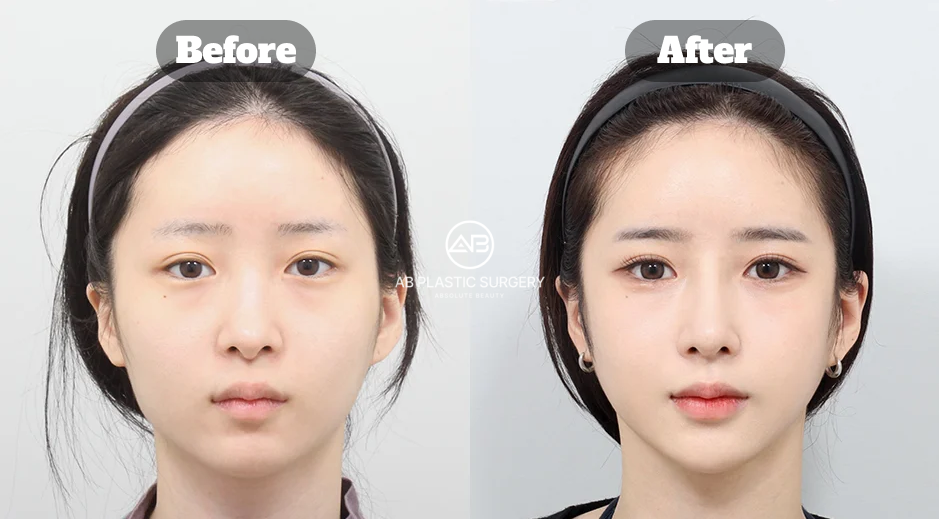
Not all wide face concerns are caused by the same factors. In facial contouring in Korea, choosing the right procedure depends on whether the facial width comes from bone structure, soft tissue, muscle, or skin laxity. Understanding this difference is essential before selecting any treatment.
While procedures like V-line surgery or cheekbone reduction are well known, not every patient requires bone surgery. Some individuals may achieve a slimmer facial appearance through less invasive options. The key is identifying what is contributing most to the wide face appearance—and understanding what each treatment cannot change.
Wide face concerns compared: what to assess and each approach’s limits
|
Main concern |
What should be assessed |
Limits to understand |
|---|---|---|
|
Wide, square lower face |
How much comes from the jawbone angle and width versus masseter muscle thickness |
Muscle treatment and bone surgery do not create the same change. Botox cannot narrow bone. |
|
Prominent cheekbones or wide mid-face |
Cheekbone (zygoma) projection and mid-face skeletal width |
Reducing fat does not change cheekbone width. Bone reduction does not tighten loose skin. |
|
Full cheeks or lower-face volume |
Where the fat sits and how elastic the skin is |
A wide face alone is not a reason to remove fat. Too much removal can look hollow or older over time. |
|
Heavy jawline from sagging |
Skin and soft tissue laxity along the cheeks and jaw |
Lifting improves definition but does not reduce skeletal width. |
This table is a general guide. Many faces have more than one contributor—for example, a wide jaw angle combined with a thick masseter muscle—so the final plan should be based on an in-person examination and imaging such as a CT scan.
Bone, Soft Tissue, Muscle, or Skin: How Each Approach Works
-
Bone contouring is recommended when the width of the face is primarily caused by the underlying bone structure, such as a square jaw or prominent cheekbones. These are surgical procedures, so swelling and recovery may take several weeks, with final results appearing gradually over time.
-
Soft tissue contouring focuses on reducing excess fat or facial volume to create a slimmer and more defined look. Recovery is generally shorter than bone contouring.
-
Non-surgical options target enlarged jaw muscles and can slim the face without altering bone or removing fat, with minimal to no downtime.
-
Supporting procedures such as rhinoplasty, brow lifts, and facelifts do not reduce skeletal width, but they can change how wide the face is perceived by improving proportion and definition.
Fullness is also not always fat. Bone shape, soft tissue thickness, and muscle can all create a similar rounded look. If that is your main concern, our guide on why a chubby face is not always caused by fat explains the medical differences in more detail.
Questions to Ask During Your Assessment
-
Which structure contributes most to my facial width—bone, fat, muscle, or skin—and is it the same on both sides?
-
Will a CT scan be used to evaluate jaw angle, cheekbone projection, and nerve position before surgery is planned?
-
If I start with a less invasive option, what change can I realistically expect, and how long will it last?
-
If more than one procedure is recommended, which specific problem does each one solve?
Bone Contouring: V-Line Surgery and Zygoma Reduction
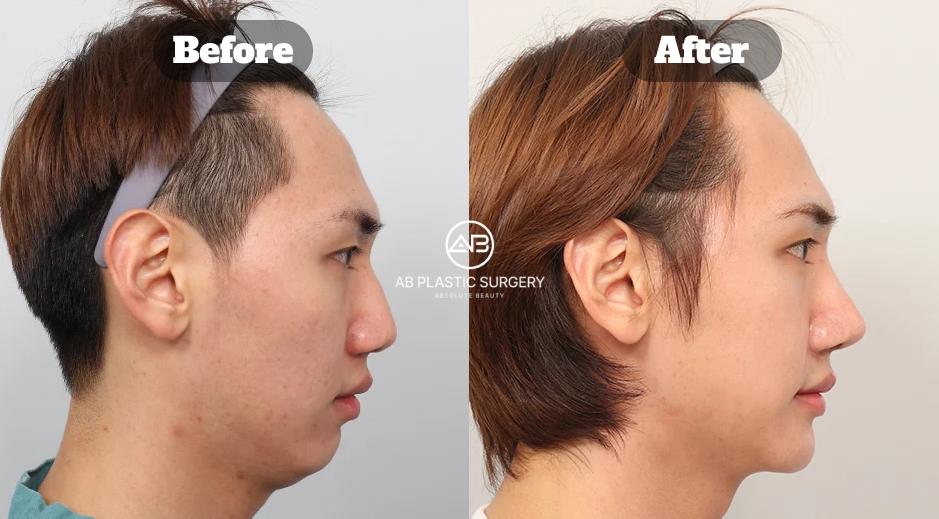
Bone contouring reshapes the facial skeleton and is the only group in this guide that directly reduces skeletal width. It is usually performed under general anesthesia, which is why surgical planning and safety systems matter as much as technique. For a detailed look at techniques and the full recovery timeline, see our facial contour surgery guide to techniques, benefits, and recovery.
1. V-Line Surgery (Mandibular Contouring): Sculpting Elegance
If your jawline feels too broad or square, V-line surgery could be a suitable solution. This procedure, favored by those seeking a delicate, V-shaped chin and jawline, involves:
-
Mandible Angle Reduction: Reduces the angle of the jawbone to slim down the lower face. The surgeon reshapes the mandible to remove the broadness, creating a more tapered look.
-
Chin Surgery (Genioplasty): Reshapes and possibly reduces the chin, further enhancing facial balance. This ensures that the chin complements the new jawline, achieving a harmonious V-shape.
Depending on your anatomy, the plan may focus more on mandible angle reduction or on chin tip surgery (genioplasty).
V-line surgery not only creates a more elegant and streamlined jawline but also enhances the overall balance and harmony of your facial features. That said, a sharp V-shape is not the only goal; some patients prefer a softer jaw that still keeps a defined angle. Our article on customized jawline design for different face shapes explains how personal preference shapes the plan.
Best suited for: Patients whose wide face is primarily caused by bone structure, particularly a square jaw or a broad lower face.
What it cannot do: It mainly changes bone. If a thick masseter muscle or excess fat is a large part of the width, those may need separate attention, and it does not tighten loose skin.
Recovery: As a bone contouring procedure, V-line surgery involves a longer recovery period compared to non-surgical or soft tissue treatments. Swelling and bruising are expected during the first few weeks, and the final facial contour becomes more visible gradually over time.
2. Zygoma Reduction Surgery (Cheekbone Reduction): Softening Prominence
Prominent cheekbones can make your face appear wider. Zygoma reduction surgery focuses on reducing and repositioning these bones to soften your facial contours.
-
Procedure: The surgeon cuts and repositions the zygomatic bones to decrease facial width. Incisions are often made inside the mouth to access the cheekbones, ensuring minimal visible scarring.
Cheekbone reduction surgery softens the prominence of cheekbones, achieving a more balanced and proportionate facial appearance. It is often considered by those whose high cheekbones give a more angular and broad look to their face.
Best suited for: Patients whose wide face is caused by prominent cheekbones or excessive mid-face width, who want smoother facial lines and improved balance.
What it cannot do: It does not reduce cheek fat or lift sagging tissue. Because the cheek soft tissue moves with the bone, patients with thin or loose tissue need bone fixation and soft tissue support planned carefully to limit cheek sagging after surgery.
Recovery: Zygoma reduction requires a recovery period that includes swelling and temporary discomfort. Most swelling improves within a few weeks, while the final facial contour becomes more defined gradually over time.
Soft Tissue Contouring: Facial Liposuction and Buccal Fat Removal
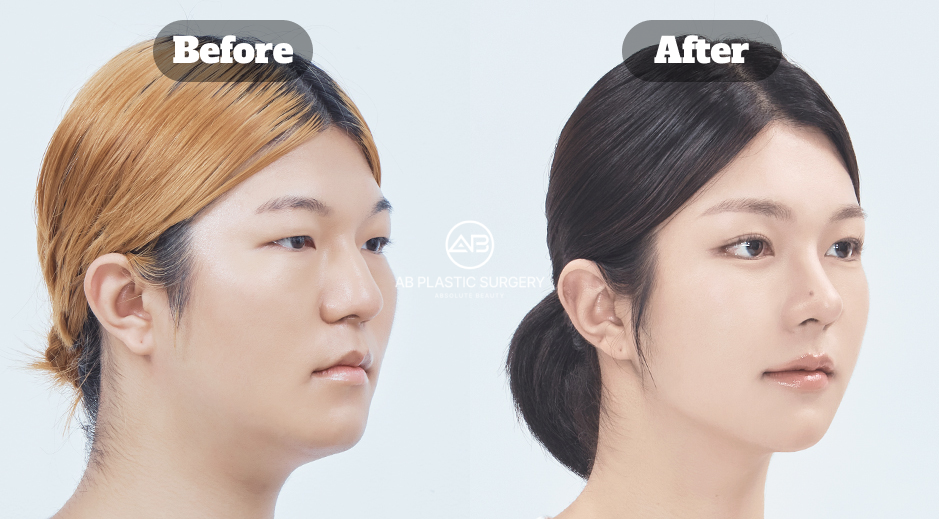
When fullness rather than bone creates width, soft tissue contouring reduces fat or volume while leaving the skeleton unchanged. The key question is not only whether fat can be removed, but whether removing it will still look balanced as the face ages.
3. Facial Liposuction: Precision Contouring
Facial liposuction targets excess fat deposits in areas like the cheeks and jawline, creating a more defined and contoured facial profile.
-
Procedure: Using fine cannulas, the surgeon performs minimally invasive removal of fat. This is particularly effective for reducing facial fullness without altering bone structure.
Facial liposuction reduces facial fullness and puffiness, creating a more sculpted and refined appearance. It is a reasonable option for those looking to remove excess fat in specific areas for a more toned look.
Best suited for: Patients whose wide face is caused by excess facial fat rather than bone structure, and whose skin still has good elasticity.
What it cannot do: It cannot narrow the jaw or cheekbones, and it cannot correct significant skin laxity. If the skin is already loose, removing fat may make sagging more noticeable.
Recovery: Facial liposuction generally involves a shorter recovery period compared to bone contouring procedures. Mild swelling and bruising may occur, but most patients can return to daily activities relatively quickly as the face gradually becomes more defined.
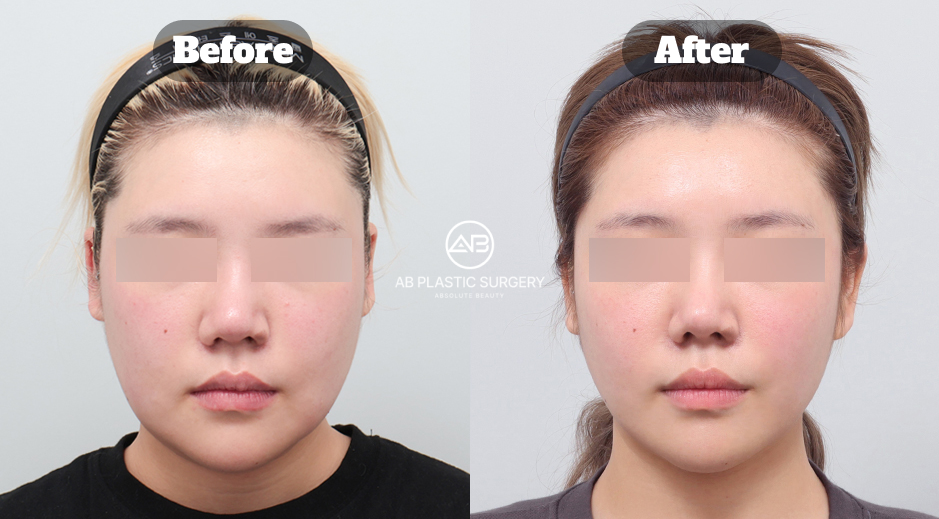
4. Buccal Fat Removal: Sculpting the Cheeks
If you have naturally fuller cheeks that give a rounded appearance, buccal fat removal might be considered. This procedure involves the extraction of fat pads from the cheeks.
-
Procedure: Through small incisions inside the mouth, the surgeon removes buccal fat pads, reducing cheek fullness. This minimally invasive procedure can result in a more contoured facial look.
In carefully selected patients, buccal fat removal reduces cheek fullness and creates sharper cheek contours. It is not, however, a general solution for every round or wide face.
Best suited for: Patients whose fuller mid-face is caused by prominent buccal fat pads, in a face that still has adequate overall volume.
What it cannot do: It does not change bone width. Facial volume naturally decreases with age, so removing buccal fat from a face that is already narrow, thin, or low in volume can lead to a hollow or prematurely aged look later.
Recovery: Buccal fat removal typically involves a relatively short recovery period. Some swelling inside the cheeks may occur, but most patients can return to normal activities as the facial contour gradually becomes more defined.
Non-Surgical Slimming: Masseter Botox
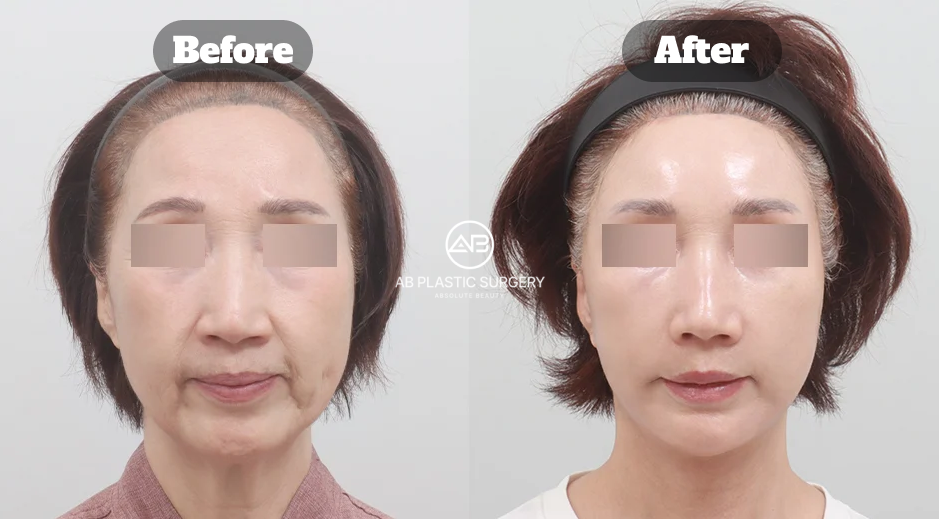
5. Botox Injections (Masseter Reduction): Non-Surgical Slimming
For those hesitant about surgery, Botox injections offer a non-surgical option to reduce jaw width. By relaxing the masseter muscles, Botox can slim down the jawline.
-
Procedure: Injections into the masseter muscles gradually reduce their size over time, leading to a slimmer jawline. The treatment itself is quick with little to no downtime, but the slimming effect develops over several weeks rather than immediately.
Botox injections are minimally invasive and provide temporary results, typically lasting several months, so repeat sessions are needed to maintain the effect. Because Botox changes muscle rather than bone, its result does not show what bone contouring surgery would achieve; the two treatments address different structures. For more ways to slim the face without surgery, read how K-pop stars slim their faces without surgery.
Best suited for: Patients whose wide lower face is caused by enlarged masseter muscles rather than bone structure or excess fat, and who want minimal downtime.
What it cannot do: It cannot narrow a wide jawbone or prominent cheekbones, and it does not remove fat.
Recovery: Most patients return to daily activities immediately after treatment, with gradual slimming appearing over the following weeks.
Supporting Procedures for Facial Balance: Rhinoplasty, Brow Lift, and Facelift
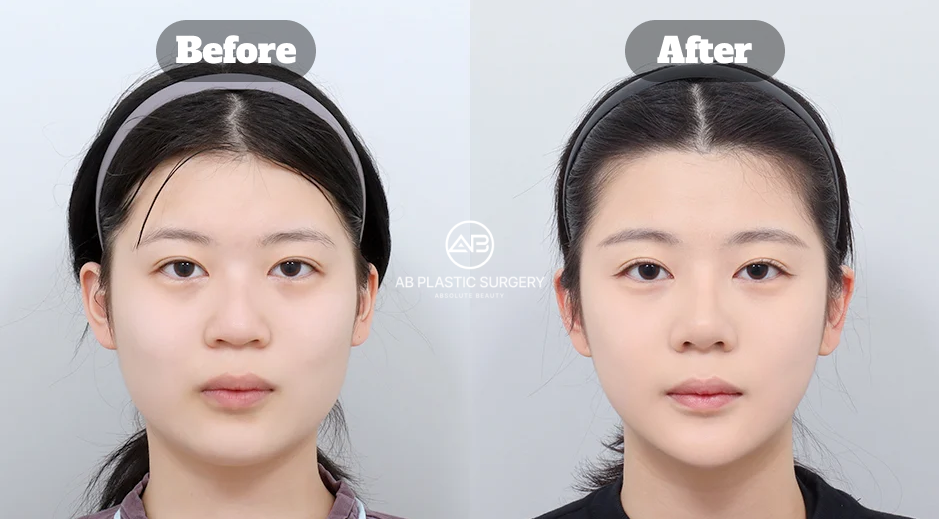
The following three procedures do not directly reduce facial width. Instead, they change how wide the face is perceived by correcting proportion, upper-face position, or sagging. This distinction matters: if your main concern is skeletal width, these procedures alone will not provide the narrowing that bone contouring does.
6. Rhinoplasty (Nose Surgery): Balancing Proportions
While not directly reducing facial width, rhinoplasty can significantly influence your face’s overall balance. A refined nose can make the entire face appear slimmer and more cohesive.
-
Procedure: The surgeon reshapes the nose to enhance facial proportions, often refining the bridge, tip, and nostrils to achieve the desired look.
Rhinoplasty enhances facial symmetry and proportions, complementing other wide face surgery procedures by balancing the central feature of the face. At AB Plastic Surgery Korea, a rhinoplasty surgeon moderated the international rhinoplasty session at APS KOREA 2025, hosted by the Korean Society for Aesthetic Plastic Surgery.
Best suited for: Patients who want to improve overall facial balance, often alongside facial contouring. It does not change jaw or cheekbone width.
Recovery: Swelling and bruising may last for several weeks, while the final refined shape of the nose becomes more visible over time.
7. Brow and Forehead Lift: Elevating Proportions
A brow and forehead lift can reshape the upper face, indirectly affecting the perceived width of the face. By elevating and reshaping these areas, you can achieve a more proportionate look.
-
Procedure: The surgery lifts and reshapes the brow and forehead area, reducing sagging and improving facial harmony. This often involves incisions within the hairline to minimize visible scarring.
A brow and forehead lift creates a more youthful and balanced facial appearance. AB Plastic Surgery Korea’s surgeons have lectured on endoscopic forehead lift techniques at APS KOREA 2025 and at the Korean Association of Plastic Surgeons’ 2025 fall training course, and the clinic has been recognized among Korea’s top five Endotine users for three consecutive years.
Best suited for: Patients whose wide face appearance is influenced by upper facial proportions or sagging brows rather than bone, fat, or muscle.
Recovery: Swelling and tightness may occur in the initial stages, with gradual improvement as the lifted contours settle into a more natural appearance.
8. Facelift: Tightening and Contouring
A facelift tightens and lifts facial tissues, reducing sagging and creating a more defined jawline. This procedure is particularly relevant when aging-related sagging makes the lower face look heavier and wider.
-
Procedure: The surgeon lifts and tightens facial tissues to improve contour and reduce sagging. This procedure can address multiple areas of the face, offering a refreshed appearance.
A facelift improves definition along the cheeks and jawline, but it does not reduce skeletal width. AB Plastic Surgery Korea’s surgeons presented on combining facelift with lower blepharoplasty at PRS KOREA 2025 and on neck lift approaches for East Asian patients at APS KOREA 2026.
Best suited for: Patients whose wide face appearance is influenced by sagging skin or aging rather than bone structure, excess fat, or muscle.
Recovery: Swelling and bruising may last for several weeks, and results continue to improve as the skin settles and healing progresses.
Wide Face Surgery Cost in Korea
The cost of wide face surgery in Korea depends on which part of the face is contributing most to facial width. Bone structure, cheek volume, jaw muscle size, nose balance, and skin sagging may all require different treatment plans. For this reason, pricing can vary depending on the procedure type, surgical complexity, anatomy, and whether multiple procedures are combined.
At AB Plastic Surgery Korea, the following starting prices apply to procedures commonly related to wide face correction and facial balance (price list dated April 29, 2026; converted at KRW 1,470 = USD 1):
|
Procedure |
Starting price |
Main factors that change the cost |
|---|---|---|
|
V-line facial contouring |
from $3,740 |
Bone anatomy, correction range, technique |
|
Square jaw reduction |
from $5,240 |
Bone anatomy, correction range, technique |
|
Genioplasty |
from $5,240 |
Bone anatomy, correction range, technique |
|
Zygoma reduction |
from $5,240 |
Bone anatomy, correction range, technique |
|
3-set facial contouring |
from $15,650 |
Combined jaw, chin, and cheekbone plan |
|
Buccal fat removal |
from $1,360 |
Anatomy and treatment range |
|
Accusculpt (per area) |
from $1,560 |
Number of areas treated |
|
Rhinoplasty |
from $3,400 |
Nose shape, materials, surgical range |
|
Forehead lifting |
from $4,490 |
Anatomy, lifting range, technique |
|
Semi full facelift |
from $5,240 |
Anatomy, lifting range, technique |
|
Full face lifting |
from $7,480 |
Anatomy, lifting range, technique |
These prices are general starting points only. The final cost may vary depending on the patient’s facial anatomy, surgical plan, correction range, anesthesia requirements, revision status, and whether additional procedures are needed. Revision facial contouring is priced individually and may cost about twice the primary procedure or more, depending on its difficulty.
Depending on the procedure and price range, AB Plastic Surgery Korea may also provide medical interpreter support, a CT scan and pre-operative health screening, swelling-relief laser care, airport pickup, hotel support of up to five nights, and an aftercare kit. These apply once surgery is confirmed, so ask your coordinator which items are included in your plan.
→ Check Wide Face Surgery Cost and Get a Personalized Treatment Schedule
Recovery, Downtime, and Safety Checks Before You Decide
Recovery time is an important factor when choosing the right treatment for a wide face. In facial contouring in Korea, recovery varies depending on whether the procedure targets bone, soft tissue, or muscle.
-
Bone contouring: Swelling and bruising are common in the first few weeks. Initial recovery takes several weeks, while final results become more defined over a few months.
-
Soft tissue contouring: Mild swelling and bruising may occur. Most patients return to daily activities relatively quickly, with gradual contour improvement.
-
Non-surgical options: Little to no downtime. Results appear gradually as muscle activity decreases.
-
Supporting procedures: Moderate recovery, with swelling that may last several weeks.
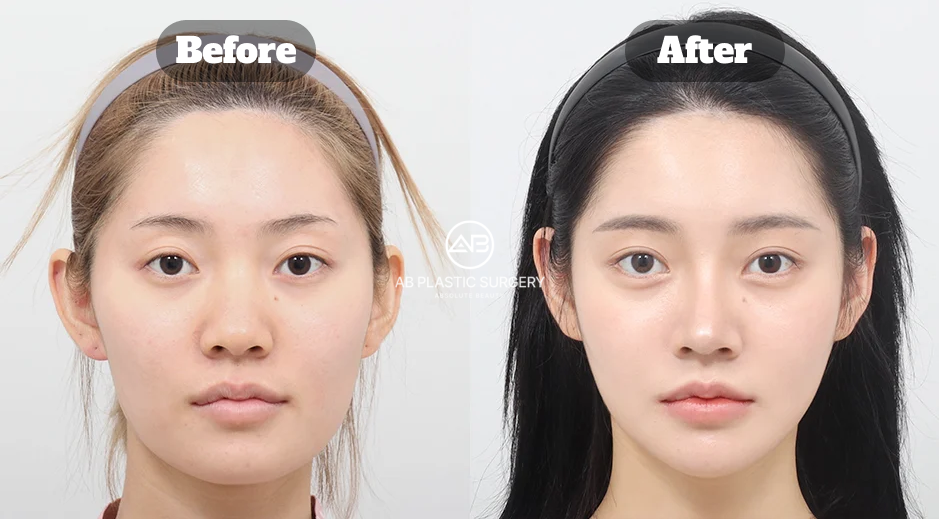
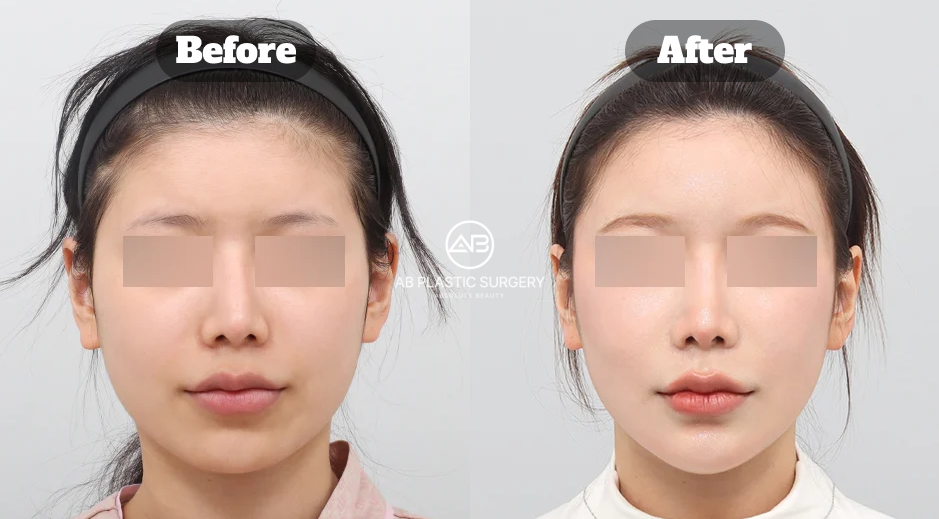
The most appropriate treatment depends not only on the cause—whether bone, fat, muscle, or skin—but also on how much recovery time a patient can accommodate. Because results keep changing for months, compare photos taken at similar time points. You can review AB Plastic Surgery Korea’s before-and-after photos by procedure, keeping in mind that individual results vary.
What to Confirm Before Facial Contouring Under General Anesthesia
For bone contouring, safety comes down to practical questions: who operates, who monitors anesthesia, and what happens if something unexpected occurs—during surgery or after you fly home.
|
What to confirm |
How AB Plastic Surgery Korea handles it |
|---|---|
|
Who actually performs your surgery |
A surgery real-name system confirms the operating surgeon, and operating rooms are monitored by CCTV. |
|
Who manages your anesthesia |
Anesthesiologists make up 47.1% of the medical staff (AB internal data, January 2026) and monitor patients from before surgery through recovery. |
|
How you are assessed before surgery |
Pre-operative tests are run in-house with an on-site clinical pathologist, and 3D-CT is used to analyze bone structure and nerve position. |
|
Readiness for bleeding or emergencies |
In-house blood crossmatching with results within about two hours, plus emergency equipment such as a defibrillator, ventilator, and backup power system. |
|
Support after you return home |
A 24-hour emergency call line and a dedicated coordinator for recovery questions and follow-up. |
For a closer look at how these steps work before, during, and after surgery, see the AB Plastic Surgery Korea medical column, written by our surgeons.
Certifications and Academic Activities You Can Verify
A certification is only meaningful if it tells you something about your own risk. For an international patient, the concern is not only the operation itself, but what happens if communication breaks down or a problem appears after surgery. The credentials below describe how those situations are managed.
-
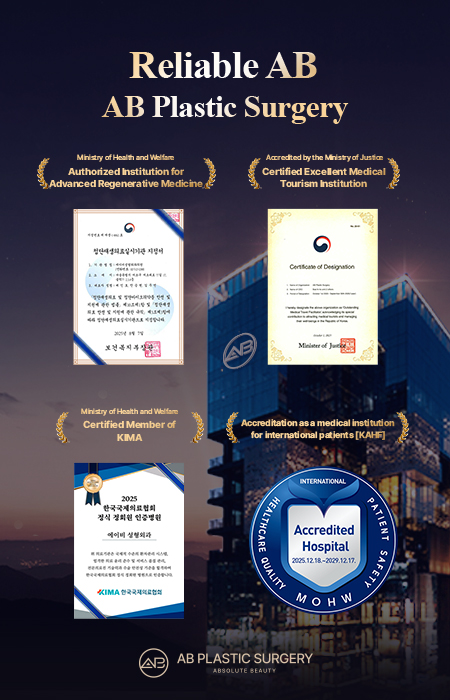
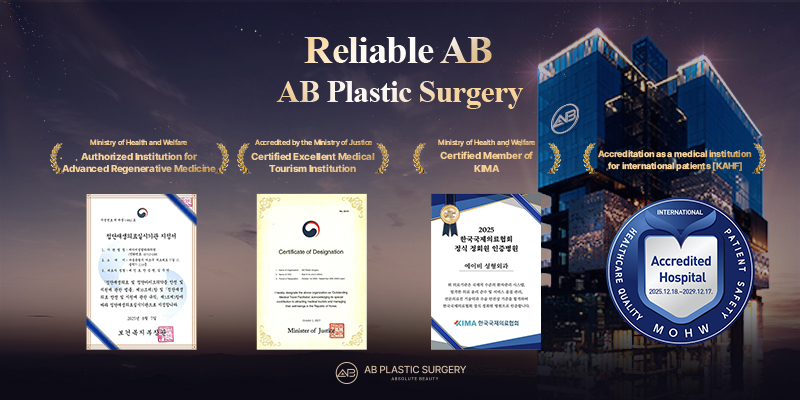
KAHF accreditation (Ministry of Health and Welfare, valid December 18, 2025 – December 17, 2029): Officially titled “Accreditation as a medical institution for international patients,” KAHF evaluates patient safety management, operating room infection prevention, staff training and emergency response, and hospital hygiene. For you, this means the systems for aftercare and problem handling were reviewed against national criteria, not only described in advertising. The certificate was presented at Medical Korea 2026.
-
KIMA full membership: Registered as a full member of the Korea International Medical Association, which reviews international patient care systems, medical quality management, and surgical safety.
-
Ministry of Justice designation: Selected as a 2025 Excellent Medical Tourism Attraction Institution, which allows international patients to use a simplified electronic medical visa process.
-
Advanced Regenerative Medicine Institution: Designated by the Ministry of Health and Welfare in 2025.
-
Safety record: Zero reported medical accident cases since opening in September 2020 (AB internal record, January 2026).
-
Academic activities: Facial contouring lecturer at IFAAS for three consecutive years, including live surgery education for overseas surgeons; lectures at APS KOREA 2025 and 2026 and PRS KOREA 2025; and clinical faculty appointments through Seoul National University Bundang Hospital’s education cooperation program.
You can find more about these credentials and the clinic’s background in the AB Plastic Surgery Korea introduction.
Frequently Asked Questions About Wide Face Surgery in Korea
How can I tell whether my wide face comes from bone, fat, or muscle?
Some signs offer clues. If the jaw corners feel firm and bulge when you clench your teeth, the masseter muscle may be a major contributor. However, bone, fat, and muscle often overlap, and a self-check cannot measure bone width. A physical examination combined with imaging such as a CT scan is the reliable way to identify which structure contributes most.
Can masseter Botox replace square jaw surgery?
Not when the width comes from bone. Botox reduces muscle bulk temporarily, while square jaw surgery changes the jawbone itself. When muscle is the main contributor, Botox may be enough. When the jaw angle is wide, Botox will not narrow it.
Will buccal fat removal make my face look narrower?
Only when prominent buccal fat pads are a real contributor to cheek fullness. It does not change bone width, and in a face that is already thin or low in volume, removal can lead to hollowness as the face ages. An assessment of overall facial volume should come first.
How much does wide face surgery cost in Korea?
Wide face surgery cost in Korea varies depending on the procedure. At AB Plastic Surgery Korea, V-line facial contouring starts from $3,740, zygoma reduction from $5,240, buccal fat removal from $1,360, rhinoplasty from $3,400, and facelift procedures from $5,240 (prices as of April 29, 2026). The final cost depends on individual anatomy, surgical complexity, and whether multiple procedures are combined, so a personalized consultation is recommended for accurate pricing.
Should I combine several procedures for a slimmer face?
Sometimes. A combination makes sense when each procedure addresses a different contributor, such as bone width and cheek fat. Adding procedures without a clear reason increases recovery time without improving results. For how combined contouring is planned, see whether multiple facial contouring procedures can be combined.
What should I check to make sure facial contouring is performed safely?
Rather than relying on general reputation, confirm these points during consultation:
-
Whether the surgeon you consult with is the surgeon who operates
-
Whether an anesthesiologist stays present from anesthesia to recovery
-
What pre-operative tests and CT-based planning are used
-
What emergency equipment and blood preparation are in place
-
How follow-up works after you return home
-
Whether the clinic holds national accreditation such as KAHF
Wide face surgery works best when the treatment matches the cause. Identifying whether bone, fat, muscle, or skin contributes most—and understanding what each option cannot change—helps you avoid unnecessary procedures and set realistic expectations. Share front and side photos with AB Plastic Surgery Korea to receive an initial assessment and a cost estimate based on your facial structure.
→ Request a Personalized Wide Face Surgery Consultation and Quote

Written by
AB Medical Editorial Team
Medically reviewed by
Updated on
October 30, 2026
This article is for informational purposes only and does not replace a personal medical consultation.