Title
Jowls Treatment: When Is Liposuction Enough, and What Makes a Facelift Considered?Date
2026-11-11Views
15
AB Blog
Jowls Treatment: When Is Liposuction Enough, and What Makes a Facelift Considered?
Table of Contents
1. What Causes Jowls? Deep Cheek Fat, Skin Laxity, and Structural Descent
2. Fat or Sag? How Jowls Are Assessed Before Jowls Treatment
3. When Liposuction Is Enough: Jowls Treatment for Deep Cheek Fat and Lower-Face Fullness
4. What Makes a Facelift Considered for Jowls and a Sagging Jawline
5. Liposuction vs. Facelift: Comparing Jowls Treatment Options Side by Side
6. Jowls Treatment FAQ: Deep Cheek Fat, Liposuction, and Facelift
7. Safety First: What to Verify Before Jowls Treatment in Korea
8. Jowls Treatment Cost in Korea and Recovery Trip Planning
If the lower edge of your face has started to soften, you have probably found two very different answers while researching jowls treatment: liposuction or a facelift. Both can improve a sagging jawline, but they work on different layers of the face. Liposuction removes fat. A facelift repositions skin and deeper tissue that has moved downward. When the chosen procedure does not match the actual cause, patients often feel the result “didn’t quite fix it.”
This guide explains how surgeons decide which jowls treatment fits a particular face. It covers what causes jowls, how deep cheek fat differs from jowl fat, the signs that liposuction alone is likely to be enough, and the signs that make a facelift the more predictable option. It also covers combined approaches, recovery timing, and USD costs for international patients planning surgery at AB Plastic Surgery Korea, where every surgical procedure is performed with a board-certified anesthesiologist on site.
Key Takeaways: Jowls Treatment at a Glance
-
The cause decides the treatment. Jowls can come from excess fat, descended skin and SMAS, lost volume and bone support, or a combination of these.
-
Liposuction may be enough when the fullness is mainly fat, the skin is still elastic, and the jawline is not hanging below the jawbone.
-
A facelift is usually considered when lifting the skin in front of the ears improves the jawline more than pinching away fat, when jowls hang below the jaw, or when the neck is also loose.
-
Deep cheek fat is not jowl fat. Deep cheek fat (buccal fat) sits in a deeper layer and is assessed and treated separately.
-
Combination is common. Many patients in their 40s and older benefit from lifting combined with targeted liposuction or fat grafting.
Jowls Treatment by the Numbers
-
3: the main mechanisms behind jowling: fat excess, tissue descent, and volume or bone loss.
-
+17%: the quarter-on-quarter rise in liposuction interest reported in RealSelf’s Q1 2026 consumer data. The same report noted a jump in deep plane facelift searches.
-
3 stages: AB Plastic Surgery’s customized lifting system (Mini, Semi, and Full Face Lifting), matched to the extent of sagging.
-
47.1%: the share of AB Plastic Surgery’s medical staff who are anesthesiology specialists, according to the clinic.
-
0: reported medical accidents since AB Plastic Surgery opened in September 2020, according to the clinic.
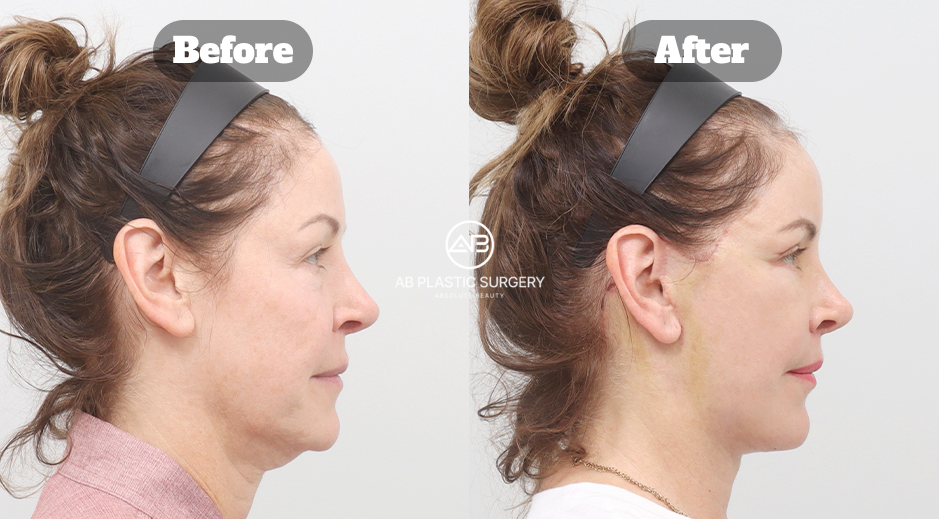
What Causes Jowls? Deep Cheek Fat, Skin Laxity, and Structural Descent
In short: Jowls are not a single problem. They form when fat gathers or slides toward the jawline, when the tissues that hold the lower face in place loosen, and when volume and bone support above the jawline decrease. Effective jowls treatment starts by identifying which of these is driving your sagging jawline.
The Three Mechanisms That Decide Your Jowls Treatment
Peer-reviewed anatomical literature indexed in PubMed Central describes several ways jowls develop. Most people have more than one:
-
Tissue descent (ptosis): With age, the retaining ligaments that anchor the cheek loosen. Superficial fat compartments then slide downward toward the jaw, carrying the skin with them.
-
Fat spilling over the jawline: The mandibular septum is a sling of connective tissue that normally holds jowl fat above the jawbone. When it weakens, fat can “flow” across the jawline and blur its edge.
-
Volume and bone loss: Midface fat deflates, the bone around the chin and jaw remodels, and the skin thins. The tissue that remains looks heavier by contrast, and a hollow can form just in front of the jowl (the prejowl sulcus).
A 2022 dissection study in Aesthetic Plastic Surgery located the jowl itself in the subcutaneous layer above the platysma muscle. It described the jowl as redundant skin and fat sitting over the back portion of the mandibular ligament. This has a practical consequence. The fat component lies in a layer that liposuction can reach, but the loosened ligaments and SMAS that allowed the fat to descend cannot be corrected by removing fat alone.
Deep Cheek Fat (Buccal Fat) vs. Jowl Fat: Different Layers, Different Treatments
“Deep cheek fat” is the term Korean patients often use for lower-cheek fullness. It refers to the buccal fat pad, an encapsulated pad of fat that sits deep beneath the facial muscles, between the cheekbone and the jaw. Jowl fat is different: it lies closer to the surface, along the jawline. The same Aesthetic Plastic Surgery study observed that a prominent buccal fat pad bulges above the jowl rather than forming part of it.
This distinction matters because both can make the lower face look heavy, yet each is reached through a different route and carries different long-term considerations.
|
Feature |
Deep Cheek Fat (Buccal Fat) |
Jowl Fat |
|---|---|---|
|
Location |
Mid-to-lower cheek, between cheekbone and jaw |
Along the jawline, beside the chin |
|
Layer |
Deep, beneath the facial muscles |
Subcutaneous, above the platysma |
|
Typical access |
Small incision inside the mouth |
Fine cannula through tiny skin incisions |
|
Common treatment |
Conservative buccal fat removal |
Liposuction, or lifting when descent dominates |
|
Main caution |
Over-removal can lead to hollow cheeks with age |
Contour irregularities and unmasked skin laxity |
Lower-face fullness is not always caused by fat in the first place. Muscle, bone width, and skin laxity can produce a similar look, as explained in AB Plastic Surgery’s guide on why a full face isn’t always caused by fat.
What Accelerates Jawline Sagging
-
Age-related laxity: Collagen and elastin decline, and the ligaments that support the cheek loosen.
-
Rapid weight loss: Deflation after significant weight loss, including weight loss with GLP-1 medications, can leave skin draped loosely over the jaw. In RealSelf’s Q1 2026 report, surgeons described energy-based tightening as a possible bridge for patients who are still losing weight and not yet ready for a facelift.
-
Bone remodeling: The jaw and chin lose projection over time, which reduces the support the lower face sits on.
-
Soft-tissue type: Heavier, thicker facial soft tissue can make descent more visible along the jawline.
-
Lifestyle factors: Sun exposure and smoking speed up the loss of skin quality.
For surgeon-written articles on facial anatomy and aging, see AB Plastic Surgery’s medical columns on facial anatomy and surgery.
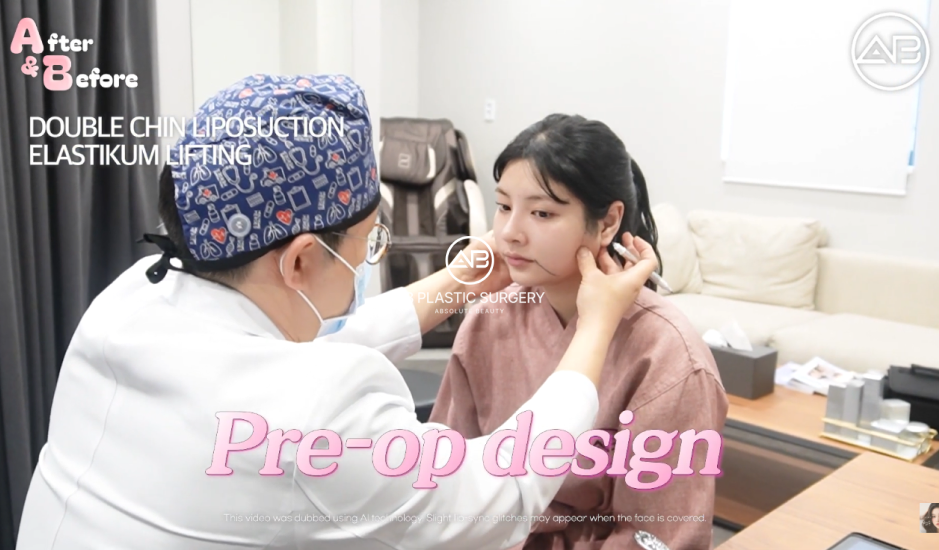
Fat or Sag? How Jowls Are Assessed Before Jowls Treatment
In short: The central question in any jowls treatment consultation is whether the jawline is blurred mainly by fat or mainly by descended tissue. A few simple self-checks can give you a preliminary sense of the answer. A surgeon then confirms it through examination and, where helpful, imaging.
Three Self-Checks You Can Try at Home
-
The pinch test: Gently pinch the fullness along your jawline. A thick, soft roll suggests that fat is a meaningful contributor.
-
The lift test: Place your fingertips just in front of your ears and gently lift the skin up and back. If your jawline sharpens dramatically, laxity is likely the main driver, and this usually points toward lifting.
-
The lying-down test: Look at your jawline in a hand mirror while lying flat. Fullness that largely disappears when you lie down suggests descent. Fullness that stays in place suggests fat.
These checks are helpful starting points, but they are not a diagnosis. Skin thickness, the position of the neck muscles, and chin projection can all change what you see in the mirror.
What a Surgeon Evaluates
-
Skin elasticity, thickness, and how far the skin can be pulled away from the jaw
-
The degree of SMAS and soft-tissue descent below the mandibular border
-
The neck: platysma bands, fat under the chin, and the chin-to-neck angle
-
Midface support, nasolabial folds, and marionette lines
-
Chin projection and any hollow in front of the jowl
-
Buccal fat prominence and overall facial width
-
Weight stability, general health, and previous facial procedures
Imaging-Based Assessment of the Lower Face and Neck
At APS KOREA 2026 on April 11, 2026, AB Plastic Surgery’s lifting team presented an imaging-based approach to neck lift planning. According to AB’s announcement of the lecture, ultrasound is used to map fat distribution relative to the platysma, and lateral X-ray is used to measure the position of the hyoid bone and the chin-to-neck angle. The same principle applies to jowls treatment: identify which layer holds the excess before deciding whether to remove it or lift it.
From Findings to a Jowls Treatment Direction
|
Assessment Finding |
Likely Jowls Treatment Direction |
|---|---|
|
Pinchable fullness, firm skin, jawline still mostly continuous |
Facial liposuction or laser-assisted Accusculpt |
|
Round lower cheek with deep fullness above the jawline and little laxity |
Deep cheek fat (buccal fat) assessment, with or without conservative liposuction |
|
Jawline sharpens markedly with the lift test; jowl hangs below the jaw |
Facelift (Mini or Semi Face Lifting, depending on extent) |
|
Jowls continue into loose neck skin or visible platysma bands |
Full Face Lifting with neck lifting or submentoplasty |
|
Both excess fat and laxity |
Facelift combined with targeted liposuction |
|
Hollow in front of the jowl and flat midface |
Volume restoration (fat grafting), with or without lifting |
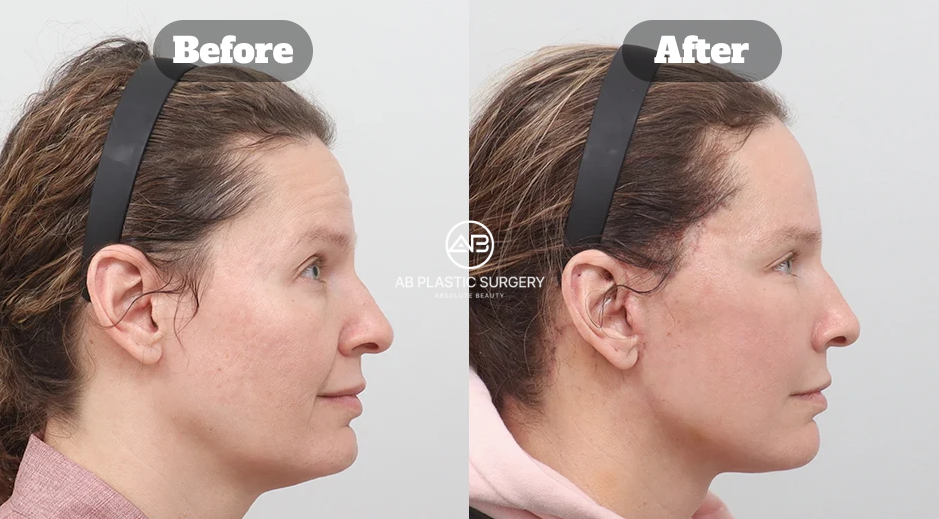
When Liposuction Is Enough: Jowls Treatment for Deep Cheek Fat and Lower-Face Fullness
In short: Liposuction can be an effective jowls treatment when the jawline is blurred by localized fat and the skin is elastic enough to contract after the fat is removed. It removes volume, but it does not reposition tissue that has descended.
Who Is a Good Candidate for Liposuction as a Jowls Treatment
-
Patients, often in their 20s to early 40s, with early blurring of the jawline
-
Fullness that is clearly pinchable and stays put when lying down
-
Good skin elasticity with little visible folding along the jaw
-
A stable body weight
-
No significant neck laxity or platysma banding
-
An expectation of contour refinement rather than lifting
Liposuction and Fat-Reduction Options for the Lower Face
Micro-Cannula Facial Liposuction
Fine cannulas are passed through tiny incisions, typically hidden near the earlobe or under the chin, to remove subcutaneous fat along the jawline and lower face. The goal is a smooth transition from cheek to jaw to neck, not maximum fat removal. For a broader look at where facial volume should be reduced, preserved, or restored, see the guide to face liposuction vs. facial fat grafting.
Laser-Assisted Liposuction (Accusculpt)
Accusculpt uses a 1,444 nm laser delivered through a thin fiber to soften fat before it is removed. The gentle heat may support a modest degree of skin contraction. AB Plastic Surgery lists Accusculpt per treatment area in its official price list. Accusculpt can refine a jowl that is mostly fat, but it is not a substitute for lifting when the tissue has descended. Your surgeon decides at consultation whether a laser-assisted or conventional technique suits your tissue.
Buccal Fat Removal for Deep Cheek Fat
When lower-cheek heaviness comes mainly from a prominent buccal fat pad, a conservative portion of that deep cheek fat can be removed through a small incision inside the mouth, leaving no external scar. This is a separate decision from treating the jowl. The buccal fat pad helps support the cheek, and natural volume loss with age can later make an over-reduced face look hollow. For that reason, conservative removal and careful patient selection are essential.
Limits and Risks of Liposuction for Jowls
-
Contour irregularities: Where there is little true excess fat, removal can leave dents or an uneven jawline.
-
Future hollowing: Aggressive removal can age the face as natural volume declines.
-
Unmasked laxity: Taking away fat from loose skin can make sagging look worse rather than better.
-
Nerve caution: The marginal mandibular branch of the facial nerve runs near the jawline. Injury is uncommon and usually temporary, but it can cause lower-lip weakness, which is why precise technique matters.
-
Recovery effects: Swelling, bruising, firmness, and temporary numbness are expected while the tissue settles.
If the lift test improves your jawline more than the pinch test does, liposuction alone is unlikely to deliver the result you are picturing.
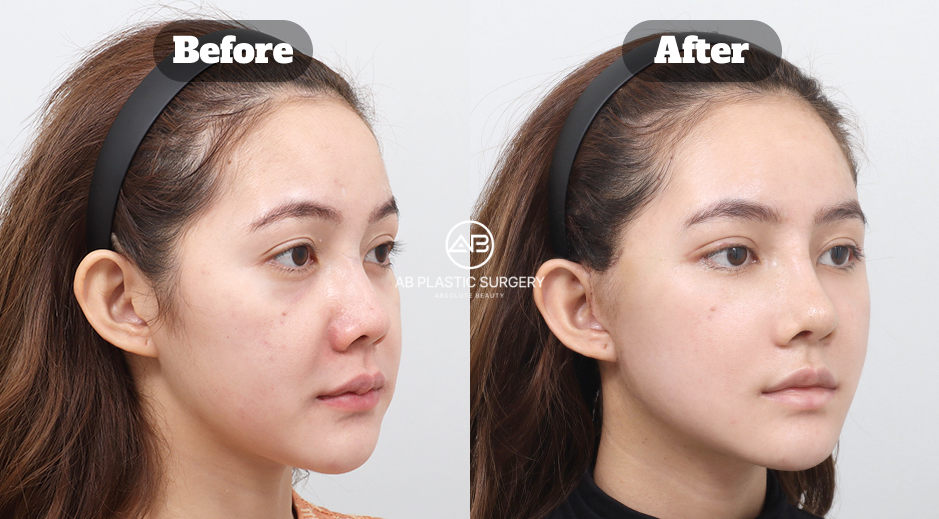
What Makes a Facelift Considered for Jowls and a Sagging Jawline
In short: A facelift becomes the more predictable jowls treatment when the jawline is blurred by descended skin and SMAS rather than by fat. Lifting repositions that tissue upward and backward along its original direction and removes the excess skin, which liposuction cannot do.
Signs That Liposuction Alone Is Likely to Disappoint
-
The lift test sharpens the jawline far more than pinching the fat does
-
The jowl hangs below the edge of the jawbone
-
Marionette lines and folds beside the mouth are deep
-
The skin feels thin and can be pulled well away from the jaw
-
The neck is also loose, or platysma bands are visible
-
Sagging has developed after previous liposuction, facial contouring, or significant weight loss
Age alone does not decide the answer. Some patients in their late 30s have meaningful descent, while some in their 50s still have mostly fat-driven fullness.
Matching Jowl Severity to AB Plastic Surgery’s 3-Stage Lifting
AB Plastic Surgery plans facial lifting in three stages. The stage is selected after analyzing the degree of aging, muscle condition, fat distribution, and skin elasticity, so the extent of surgery matches the extent of sagging.
|
Stage |
Approach |
Often Considered For |
|---|---|---|
|
Mini Face Lifting |
Minimal incision and dissection, targeted lifting of key areas |
Early jowling in a limited area; patients concerned about scars |
|
Semi Face Lifting |
Sufficient SMAS dissection for the mid and lower face, excluding the neck |
Moderate jowls without neck sagging; sagging after contouring or weight loss |
|
Full Face Lifting |
Maximal SMAS dissection covering the face and neck |
Advanced jowls that continue into neck laxity and deep folds |
Within these stages, the plane of dissection is also tailored. AB Plastic Surgery’s facelift page describes using a deep plane technique, which lifts the skin and SMAS together and is suited to thinner skin and SMAS, and a dual plane technique, which dissects each layer separately and is suited to thicker tissue. The clinic states that its surgeons release the retaining ligaments in each area while avoiding nerves and vessels, which supports longer-lasting jowl correction. For a deeper comparison of these techniques, read how a deep plane facelift differs from SMAS and traditional facelifts.
When the Neck Is Part of the Problem
Jowls rarely end exactly at the jawline. When loose skin and fat continue into the neck, a facelift that addresses only the face can leave a visible step between a refreshed jawline and an aging neck. Neck lifting and submentoplasty, which tightens the platysma muscle beneath the chin, are often planned alongside lifting in these cases.
In its APS KOREA 2026 lecture on neck lifting for East Asian patients, AB Plastic Surgery’s team described a layer-based approach. Its announcement noted that many East Asian patients have relatively thick subcutaneous fat over a comparatively thin platysma. In shorter necks, fat removal alone has clear limits, and the underlying muscle often needs to be addressed as well. To decide which of these procedures fits your concern, compare neck lift vs. facelift, or read about defining the jawline when a double chin is involved.
Liposuction vs. Facelift: Comparing Jowls Treatment Options Side by Side
In short: Liposuction reduces volume, and a facelift restores position. When both problems are present, combining them is often the most complete jowls treatment.
|
Comparison |
Liposuction / Accusculpt |
Facelift (Mini to Full) |
|---|---|---|
|
What it treats |
Localized excess fat |
Descended skin, SMAS, and soft tissue |
|
Layer |
Subcutaneous fat |
Skin plus SMAS (deep or dual plane) |
|
Best candidate |
Fat-dominant fullness with elastic skin |
Laxity-dominant jowls, often with neck changes |
|
Anesthesia |
Planned and monitored by an on-site anesthesiologist according to the procedure and the patient’s health |
|
|
Incisions |
A few tiny entry points |
Concealed around the hairline and ear, length varies by stage |
|
Early recovery |
Swelling and bruising for roughly 1 to 2 weeks |
Social downtime commonly 2 to 3 weeks |
|
Typical stay in Seoul |
About 5 to 7 days |
About 10 to 14 days |
|
Longevity |
Removed fat cells do not return, but weight change and aging continue |
Long-lasting repositioning, though aging continues |
|
Starting price at AB |
Accusculpt from $1,560 per area |
Semi Full Facelift from $5,240 |
Stay lengths are general planning guides. Your medical team will confirm your follow-up schedule based on the procedure performed and how you heal.
Combining Liposuction With a Facelift
Many patients have both excess fat and laxity, and in these cases combining procedures tends to give the most complete jowls treatment. During a facelift, the surgeon can contour fat along the jawline and under the chin while the skin is being redraped, which reduces the risk of the irregularities that can occur when liposuction is performed on loose skin. Where volume has been lost above the jowl, fat grafting to the midface or the prejowl hollow can restore smoother transitions.
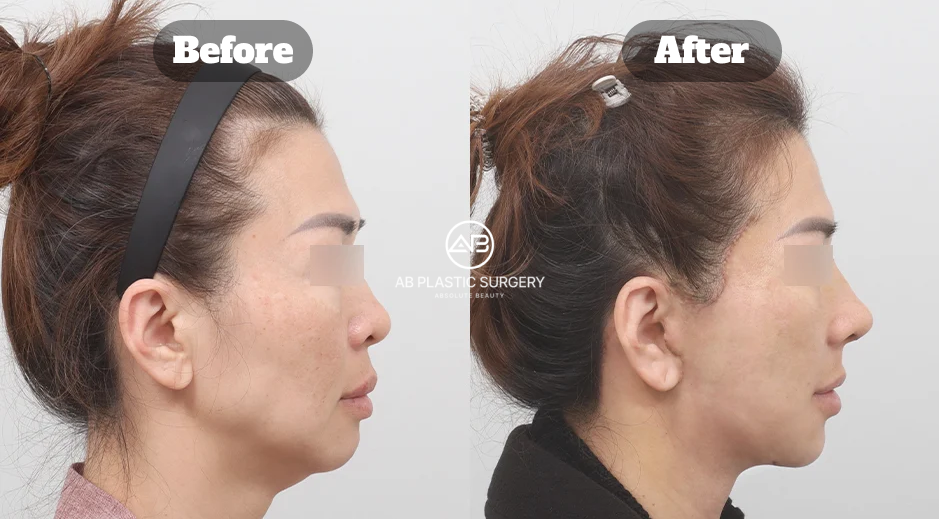
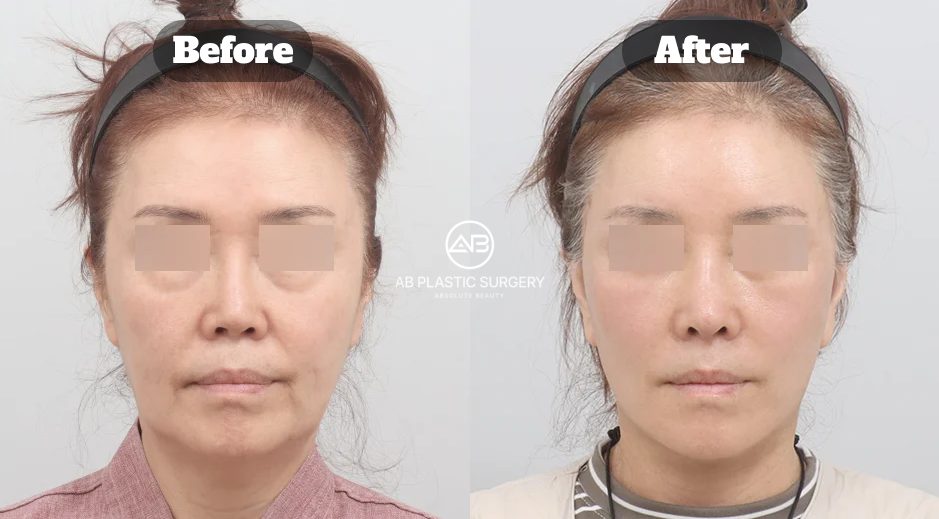
AB Plastic Surgery’s published patient cases include combinations such as a facelift with fat grafting and liposuction, and a mini facelift with forehead lifting, fat grafting, and double-chin liposuction. You can review real jowls treatment before-and-after results in the clinic’s gallery.
Where Non-Surgical Options Fit
Non-surgical treatments can support jowls treatment, but they work best as a bridge or for maintenance rather than as a replacement for surgery when descent is significant:
-
Thread lifting: Gives a temporary lift for mild jowling with minimal downtime. The effect gradually softens over time.
-
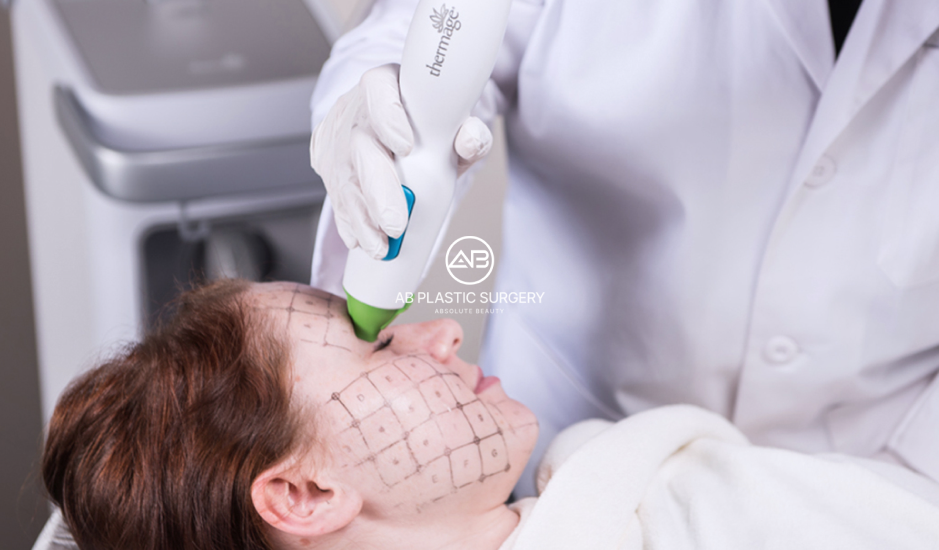
Ultherapy and Thermage: Focused ultrasound and radiofrequency improve skin quality and firmness, with modest tightening that develops over months.
-
Regenerative care: Treatments that support skin quality and post-operative recovery are increasingly combined with surgery. They do not lift tissue on their own.
For more lifting, contouring, and skin guides written for international patients, browse the AB Plastic Surgery blog.
Jowls Treatment FAQ: Deep Cheek Fat, Liposuction, and Facelift
Can liposuction alone be an effective jowls treatment?
Yes, when the jowl is mainly localized fat and the skin is still elastic. Liposuction removes fat but does not lift descended skin or SMAS. If lifting the skin in front of your ears improves your jawline more than pinching away fat, a facelift or a combined approach is usually more predictable.
Can jowls come back after liposuction?
Removed fat cells do not regenerate. However, the remaining fat cells can enlarge with weight gain, and natural aging continues to loosen the tissues that support the lower face. Over time, new jowling can develop from descent rather than fat, and at that stage lifting becomes the relevant jowls treatment.
Is deep cheek fat removal the same as jowl liposuction?
No. Deep cheek fat removal targets the buccal fat pad, which sits deep beneath the facial muscles and is reached through an incision inside the mouth. Jowl liposuction removes subcutaneous fat along the jawline through tiny skin incisions. The two are assessed separately, and buccal fat is reduced conservatively to avoid hollowing as the face ages.
Am I too young for a facelift as a jowls treatment?
Not necessarily. Candidacy depends on anatomy, not age alone. Some patients in their late 30s or 40s have meaningful descent that liposuction cannot correct, and a limited approach such as Mini or Semi Face Lifting may suit them. Others in their 50s still have mostly fat-driven fullness. An in-person assessment is the only reliable way to decide.
Can a thread lift or Ultherapy replace a facelift for jowls?
For mild jowling, a thread lift or energy-based tightening can provide visible but temporary improvement. These treatments do not reposition significantly descended SMAS or remove excess skin. When the jowl hangs below the jawbone, they are best used for maintenance or as a bridge rather than as a replacement for surgical lifting.
How long should I stay in Korea for jowls treatment?
As a general planning guide:
-
Facial liposuction, Accusculpt, or buccal fat removal: about 5 to 7 days
-
Mini Face Lifting: about 7 to 10 days
-
Semi or Full Face Lifting, with or without neck lifting: about 10 to 14 days
Your medical team will confirm the follow-up schedule for your specific plan.
Safety First: What to Verify Before Jowls Treatment in Korea
In short: Whichever jowls treatment you choose, the clinic’s safety systems matter as much as its technique. Anesthesia management, emergency readiness, and independent accreditation are the points international patients should verify before booking.
Anesthesia and Surgical Safety Systems
AB Plastic Surgery states that it maintains the following safety measures:
-
On-site anesthesiologists: A board-certified anesthesiologist is present for every surgical procedure and manages care from pre-operation through recovery. According to the clinic, anesthesiology specialists make up 47.1% of its medical staff.
-
Real-time monitoring: Patients are monitored in real time during anesthesia, with cross-verification through central monitoring systems.
-
Transparent operating rooms: CCTV recording in the operating rooms and a surgeon-of-record system that confirms who performs each surgery.
-
Pre-operative screening: Blood tests, ECG, X-ray, and 3D-CT are performed through the clinic’s in-house facilities.
-
Emergency readiness: In-house blood crossmatching with results available within about two hours, hospital-level emergency equipment, and a 24-hour emergency line for patients after discharge.
-
Safety record: The clinic reports zero medical accidents since its opening in September 2020.
Government Accreditation and Institutional Credentials
-
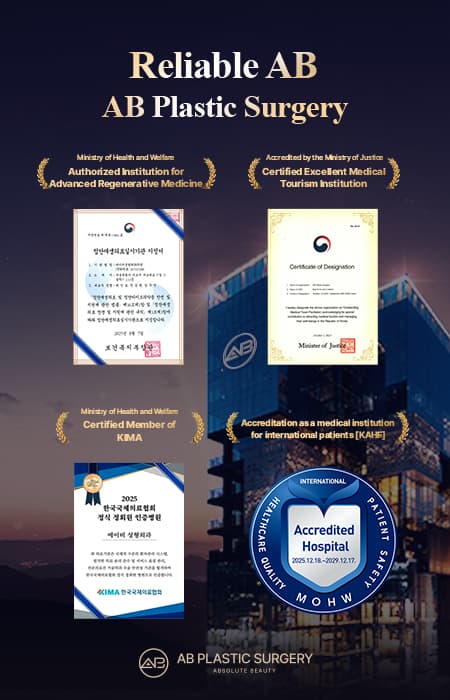
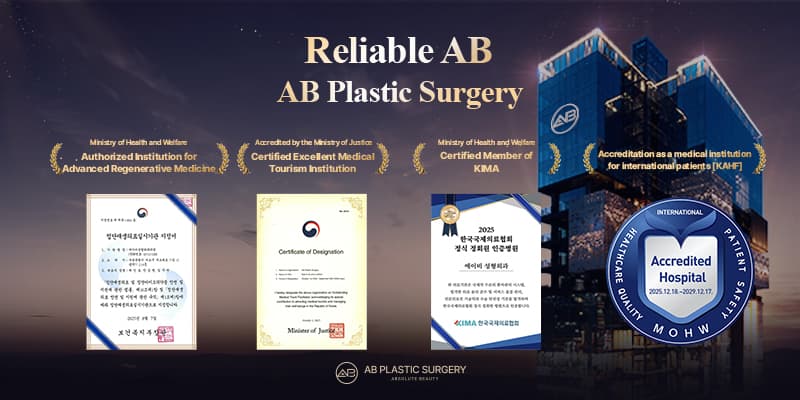
KAHF accreditation: AB Plastic Surgery is accredited under Korea’s Ministry of Health and Welfare program for medical institutions serving international patients. The program evaluates patient safety, infection control, emergency processes, and international patient care, and accredited hospitals can be checked in Medical Korea’s official directory.
-
KIMA full membership: The clinic is a full member hospital of the Korea International Medical Association.
-
Excellent Medical Tourism Institution (2025): The clinic was designated by Korea’s Ministry of Justice.
-
Advanced Regenerative Medicine Institution: AB Plastic Surgery’s stem cell center was designated by the Ministry of Health and Welfare in 2025.
-
Academic partnerships: The clinic has an education cooperation agreement with Seoul National University Bundang Hospital and a clinical cooperation agreement with Hallym University Dongtan Sacred Heart Hospital.
Accreditation does not guarantee an individual outcome. It does show that a clinic’s systems have been reviewed against national standards. Learn more about AB Plastic Surgery’s accreditations and safety system.
Lifting Expertise Recognized by Peers
A useful signal when choosing a surgeon for jowls treatment is whether other plastic surgeons invite that team to teach. AB Plastic Surgery’s lifting surgeons have presented at major academic meetings:
-
APS KOREA 2026 (April 11, 2026): The clinic’s team gave two neck lift lectures. One covered imaging-based evaluation of chin and neck anatomy; the other covered refined neck lift approaches tailored to East Asian anatomy.
-
PRS KOREA 2025 (November 9, 2025): Dr. Choi Jae-Ik spoke on combining a facelift with lower blepharoplasty. According to AB’s summary, the talk emphasized preserving the orbicularis muscle, repositioning skin and SMAS before precise skin trimming, and keeping midface dissection conservative to support recovery.
-
APS KOREA 2025 (April 2025): Dr. Choi Jae-Ik chaired and spoke in the session on facial aging, presenting deep plane facelift and endoscopic forehead lift techniques for Asian patients.
-
IFAAS: AB Plastic Surgery reports being selected as an IFAAS lecture institution for three consecutive years, hosting overseas surgeons for lectures and live surgery. This places the team in the role of teaching technique, not only learning it.
You can review surgeon backgrounds and specialties when you meet AB Plastic Surgery’s lifting specialists.
Jowls Treatment Cost in Korea and Recovery Trip Planning
In short: Jowls treatment costs at AB Plastic Surgery range from a single-area Accusculpt procedure to a full face and neck lift. Your final quote depends on the procedures combined, the extent of treatment, and the anesthesia plan.
Jowls Treatment Price Guide (USD)
|
Procedure |
Starting Price (USD) |
|---|---|
|
Accusculpt (per area) |
$1,560~ |
|
Buccal Fat Removal (deep cheek fat) |
$1,360~ |
|
Facial Liposuction (jowl / double chin) |
Quoted at consultation |
|
Mini Face Lifting |
Quoted at consultation |
|
Semi Full Facelift |
$5,240~ |
|
Full Face Lifting |
$7,480~ |
|
Facelift with 3-Stage Customized Program |
$7,200 |
|
Neck Lifting |
$2,990~ |
|
Submentoplasty |
$3,740 |
|
Lower Blepharoplasty + Mid Face Lifting |
$4,490~ |
|
Mint Thread Lifting / Elasticum Thread Lifting |
$2,240~ / $3,740~ |
|
Full Face Fat Grafting (1st session) |
$1,700~ |
A note on these figures: they are starting prices drawn from AB Plastic Surgery’s official price list and are published so you can budget realistically, not as a fixed quote. Your final price reflects your anatomy, the number of areas treated, any procedures combined in the same session, and your anesthesia plan, and it is confirmed only after a consultation. Amounts are converted from KRW, so the final USD figure may shift slightly with exchange rates.
How Long to Stay in Seoul
|
Jowls Treatment Plan |
Suggested Stay |
Planning Note |
|---|---|---|
|
Facial liposuction, Accusculpt, or buccal fat removal |
About 5 to 7 days |
Swelling settles gradually over the following weeks |
|
Mini Face Lifting |
About 7 to 10 days |
Allow time for the post-operative check |
|
Semi or Full Face Lifting, with or without neck lifting |
About 10 to 14 days |
Includes suture removal and follow-up checks before flying home |
After lifting surgery, AB Plastic Surgery offers post-operative care that may include stem-cell-based recovery support, dermatology collaboration for swelling and scar care, and hyperbaric oxygen therapy. The care plan depends on your procedure.
Support for International Patients
According to AB Plastic Surgery, patients who confirm surgery may receive medical interpretation, a complimentary CT scan and health screening, swelling-care laser treatment, airport pickup, up to five nights of hotel accommodation, and an aftercare kit. These benefits vary by procedure type and price range and do not allow a specific surgeon to be reserved in advance. Confirm what applies to your plan before booking.
Choosing the Right Jowls Treatment
The most effective jowls treatment is the one that matches the cause. If your jawline is blurred mainly by fat and your skin is still elastic, liposuction, Accusculpt, or conservative deep cheek fat reduction may be all you need. If the lift test changes your face more than the pinch test does, a tailored facelift, often combined with targeted liposuction, is the more predictable route to a defined jawline. In every case, the result depends on accurate assessment and on a clinic where an anesthesiologist manages your safety from start to finish.
To find out which jowls treatment suits your face, send photos for a preliminary review and get a personalized jowls treatment quote.
This content is provided for general information and does not replace an in-person medical consultation. Candidacy, recovery, risks, and results vary with individual anatomy, health, and the extent of treatment. Safety records, staffing figures, and patient benefits described above are as stated by AB Plastic Surgery.

This article is for informational purposes only and does not replace a personal medical consultation.